
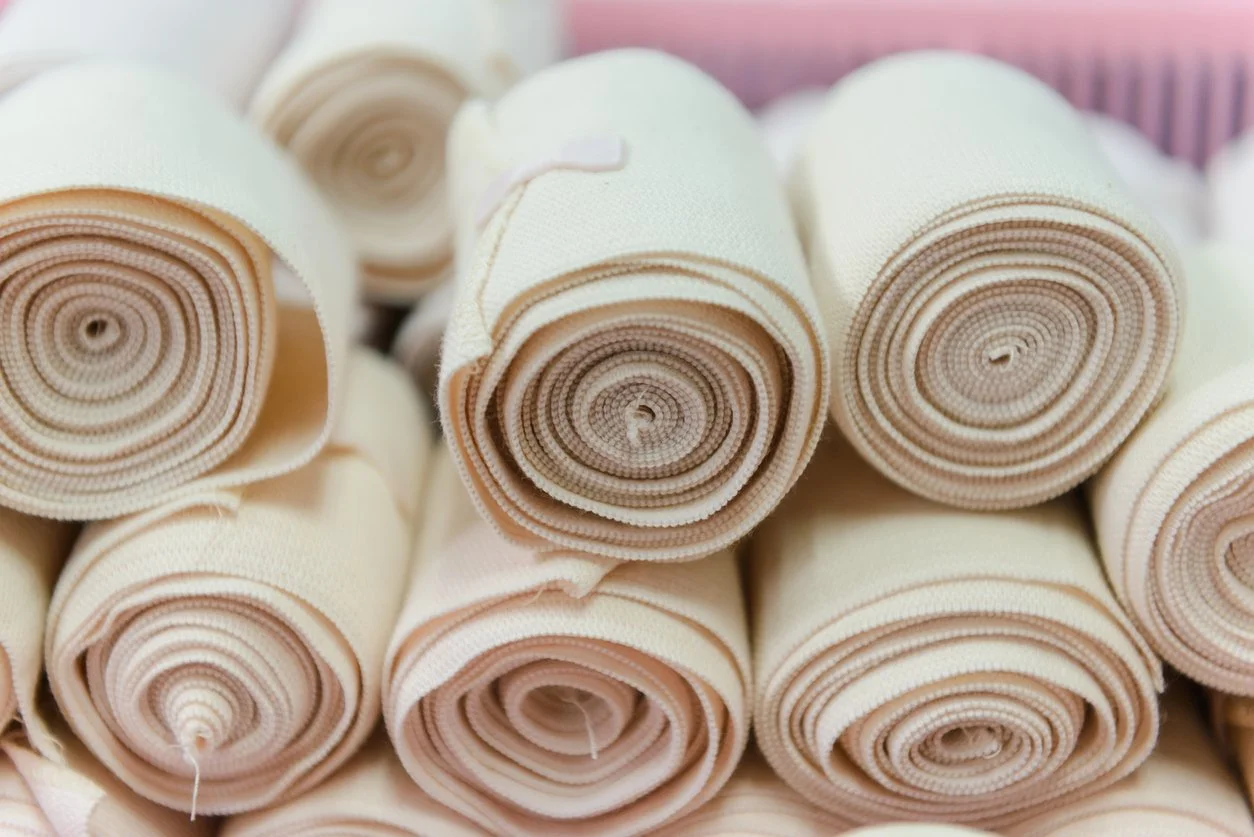
Walk into any pharmacy in New York City and you will find Ace bandages — beige, elastic, familiar, widely available. If you have recently been told that you need compression bandaging for lymphedema, the Ace bandage is almost certainly the first thing that comes to mind. It is also almost certainly the wrong choice — and the reason why tells you something important about how lymphedema treatment actually works.
Short-stretch bandages and Ace bandages look similar. They are both wrapped around a limb. They both provide compression. But they work through entirely different mechanisms, and using the wrong one in lymphedema management is not simply a matter of preference — it can actively work against treatment goals and, in some cases, cause harm.
At Thera Physical and Occupational Therapy in Midtown Manhattan, our Certified Lymphedema Therapists (CLTs) apply short-stretch bandaging as part of Complete Decongestive Therapy (CDT) — the gold standard protocol for lymphedema management. This post explains what makes short-stretch bandages different, why those differences matter clinically, and why Ace bandages are the wrong tool for lymphedema.
The concept of working pressure and resting pressure
To understand why these two bandages behave so differently, you need to understand two concepts: working pressure and resting pressure.
Working pressure is the resistance a bandage creates against the outward expansion of the limb during muscle contraction. When you walk, flex your calf, or move your arm, the muscles inside the limb contract and push outward against the surrounding tissue. A bandage with high working pressure resists this outward expansion, creating an inward counterforce that drives lymphatic and venous fluid upward — out of the congested area and toward the body's core. This is the pumping mechanism that makes compression therapeutically active during movement.
Resting pressure is the pressure a bandage applies to the limb when the muscles are at rest — when you are sitting, lying down, or sleeping. High resting pressure means the bandage continues to compress the limb with significant force even when the limb is not moving. This is a problem, not a benefit: high resting pressure restricts blood flow, is uncomfortable, and can create a tourniquet-like effect that actually impairs the drainage it is meant to support.
The ideal therapeutic bandage for lymphedema has high working pressure and low resting pressure. The muscle pump is activated during movement and drives fluid out of the limb. During rest, the bandage maintains position and prevents re-accumulation without creating constriction. This is precisely what short-stretch bandages are designed to do — and precisely what Ace bandages do not.
Short-stretch bandages: how they work
Short-stretch bandages — also called inelastic bandages — are woven from cotton fibers in a way that allows only approximately 30 to 60 percent extensibility of their original length. When applied to a limb, they do not stretch significantly once they are in place. They are, in the language of compression therapy, "stiff."
This stiffness is their therapeutic mechanism. When the muscles beneath the bandage contract during movement, the muscle bulk pushes outward against the inelastic bandage wall — and the bandage, unable to stretch, pushes back with equal and opposite force. That counterforce drives the muscle pump action that moves lymphatic fluid proximally. The bandage functions like a rigid external casing that amplifies the natural pumping effect of the muscles.
At rest, the short-stretch bandage does not recoil. Because it has minimal inherent elasticity, it simply lies against the limb without generating significant pressure. Resting pressure is low. The patient can sleep in short-stretch bandaging — which is a standard part of the intensive phase of CDT — without the circulation impairment that high resting pressure would create.
Short-stretch bandages are the clinical standard for lymphedema bandaging. The evidence base for their use is robust. Clinical literature consistently identifies short-stretch bandaging as more effective and safer for lymphedema management than any long-stretch alternative.
Ace bandages: why they are the wrong tool
Ace bandages are long-stretch elastic bandages — they can extend to 150 to 200 percent of their original length. This high elasticity is what makes them useful for general wound care, joint support, and acute injury compression: they conform to the limb, apply consistent pressure, and are easy to apply without specialized training.
The problem for lymphedema management is that the same elastic properties that make Ace bandages convenient also make them therapeutically counterproductive:
- High resting pressure. Because Ace bandages have high elasticity, they continuously attempt to return to their original shorter length — generating ongoing pressure against the limb even at rest. This high resting pressure is uncomfortable during prolonged wear and restricts blood flow during the rest periods when it should be minimal.
- Low working pressure. When the muscles contract against an elastic bandage, the bandage stretches to accommodate the expansion rather than resisting it. The counterforce — the mechanism that drives the muscle pump — is significantly reduced compared to a stiff short-stretch bandage. The therapeutic pumping effect is weak.
- Loss of compression over time. Elastic bandages lose tension as they are worn. An Ace bandage applied in the morning with meaningful compression may be providing significantly less compression by the afternoon — without any visible sign that this has occurred. Short-stretch bandages, because they do not rely on elastic recoil, maintain their working pressure profile much more consistently over the wearing period.
- Must be removed during rest. Because of their high resting pressure, long-stretch elastic bandages should not be worn during sleep or prolonged rest — they risk constriction. This limits their utility in the intensive phase of CDT, during which bandaging is worn for up to twenty-three hours per day including overnight.
- Stretch: Short stretch — 30–60% | Ace — 150–200%
- Working pressure: Short stretch — HIGH (resists muscle expansion) | Ace — LOW (stretches to accommodate it)
- Resting pressure: Short stretch — LOW (safe for overnight wear) | Ace — HIGH (must be removed during rest)
- Maintains pressure over time: Short stretch — YES | Ace — NO (loses tension during wear)
- Safe to sleep in: Short stretch — YES | Ace — NO
- Clinical standard for lymphedema: Short stretch — YES | Ace — NO
- Appropriate use: Short stretch — CDT bandaging for lymphedema | Ace — acute injury, wound support, general joint compression
What happens when an Ace bandage is used for lymphedema
Patients who use Ace bandages for lymphedema — either because they were not clearly advised otherwise, or because they purchased what was available at a pharmacy — typically report one or more of the following: the bandage feels uncomfortably tight when they are resting or sleeping, they remove it at night because of discomfort, the arm or leg feels worse in the morning than it did before wrapping, or the swelling is not improving as expected.
These experiences are a predictable consequence of using a high-resting-pressure elastic bandage in a context that requires low resting pressure and high working pressure. The bandage is not defective — it is the wrong tool.
If you have been using Ace bandages for lymphedema management and your results have been disappointing, the bandage itself may be part of the explanation. Transitioning to professionally applied short-stretch bandaging — as part of a formal CDT protocol at Thera — is often the turning point at which patients who have been struggling with self-management begin to make meaningful progress.
What about compression garments?
Compression garments — sleeves and stockings — are also elastic and long-stretch in their construction. They are not the same as Ace bandages, and they play an essential role in lymphedema management. The difference is that garments are custom-fitted to your limb, engineered to deliver a specific and consistent compression class, and worn during the maintenance phase of care when the goal is sustaining volume that has already been reduced — not actively reducing acute swelling.
Garments provide resting pressure, not working pressure in the therapeutic sense. They are appropriate for long-term maintenance. They are not a substitute for short-stretch bandaging during the intensive phase of CDT, and they are not effective for reducing significant swelling that has not yet been treated. The intensive phase uses short-stretch bandaging precisely because it provides working pressure that garments cannot. Learn more about professional compression garment fitting at Thera.
Lymphedema bandaging at Thera in NYC
Short-stretch bandaging is a clinical skill. The technique, the layering sequence, the foam placement, the tension, and the pattern of overlap are all components of a therapeutic system that requires training to apply correctly. Incorrectly applied short-stretch bandaging — even with the right material — will not produce the working pressure gradient needed for effective treatment.
At Thera, our CLTs apply professionally constructed multi-layer short-stretch bandage systems as part of our CDT protocol. We also teach patients how to perform their own self-bandaging safely for overnight use and between sessions. No referral is needed. If you are managing lymphedema and have questions about your current compression approach, contact our team today to schedule an evaluation at our Midtown Manhattan clinic.
Short-stretch bandages and Ace bandages look similar but work through opposite mechanisms. Short-stretch bandages have high working pressure and low resting pressure — they activate the muscle pump during movement and are safe to wear overnight. Ace bandages have low working pressure and high resting pressure — they compress the limb at rest but do not effectively drive the muscle pump and are not safe for extended wear. For lymphedema management, short-stretch bandages are the clinical standard. An Ace bandage from the pharmacy is not a substitute, and using one in place of proper CDT bandaging is one of the most common reasons patients plateau or fail to progress in self-managed lymphedema care.
If you are managing lymphedema and want to understand whether your current compression approach is right for your stage and presentation, contact our team today to schedule an evaluation at our Midtown Manhattan clinic.
No referral needed · New York State allows direct access to physical and occupational therapy for up to 10 visits or one month without a physician's script.