
If you have been told you have lymphedema — or you are at risk after cancer treatment or surgery — you may have done enough research to know that treatment exists, that it helps, and that you probably need it. But knowing all of that does not necessarily make picking up the phone and booking a first appointment feel any less daunting.
What actually happens in a lymphedema treatment session? Will it hurt? Will you have to undress? How long does it take, and how many sessions will you need? These are the questions patients most often ask us before their first visit at Thera Physical and Occupational Therapy in Midtown Manhattan — and they are exactly the right questions to be asking.
This guide walks you through what to expect, from the moment you arrive to the plan we build for your care. Our goal is to remove every barrier that stands between you and the treatment you need.
Who treats lymphedema at Thera?
Lymphedema is not a condition that responds to general physical or occupational therapy. It requires a therapist with advanced, specialized training in the lymphatic system and in the clinical protocols developed specifically for lymphedema management.
At Thera, your care is provided by a Certified Lymphedema Therapist (CLT) — a physical or occupational therapist who has completed a formal post-graduate lymphedema training program and passed a certifying examination. CLTs are trained in the full scope of Complete Decongestive Therapy (CDT), the gold standard treatment protocol endorsed by the National Lymphedema Network.
Every session at Thera is one-on-one. You will not share your appointment with another patient, and your therapist will not be moving between rooms. The session belongs entirely to you.
Before your first session: what to bring and how to prepare
Your first appointment is an evaluation, not just a treatment. Coming prepared helps your therapist understand your full picture quickly and begin building a care plan that fits your actual situation — not a generic protocol.
It helps to bring:
- Any imaging, pathology reports, or surgical notes related to your diagnosis or treatment
- A list of current medications, including any diuretics or compression garments you have been using
- The compression garments you currently own, if any — your therapist will assess whether they are the right fit and type for your condition
- Notes about when symptoms started, what makes them better or worse, and any activities or positions that affect your swelling
Wear comfortable, loose-fitting clothing that allows easy access to the affected limb or area. If your lymphedema affects your arm, a loose short-sleeved shirt or tank top is ideal. If it affects your leg, shorts or loose pants you can roll up easily will work well. You do not need to bring anything special — your therapist will guide you through anything else on the day.
What happens during your first session
A thorough intake and history
Your first session begins with a detailed conversation. Your therapist will review your medical history, your current diagnosis, your surgical and treatment history, and what brought you in. For patients who developed lymphedema after breast cancer surgery or treatment, this includes a careful look at which lymph nodes were removed or irradiated and what the treatment timeline looked like. For patients with primary lymphedema, we explore when symptoms first appeared and how they have changed over time.
This is also the time to tell your therapist everything — including things you may have been embarrassed to mention elsewhere. There is no such thing as too much information in a lymphedema evaluation.
Physical assessment and limb measurements
Your therapist will perform a hands-on physical assessment of the affected area. This includes examining the skin, assessing tissue texture and firmness, checking for the Stemmer sign (a clinical indicator of lymphedema in the hands or feet), and evaluating range of motion in the affected limb and surrounding joints.
Precise circumferential measurements of your limb will be taken at multiple points and recorded as your baseline. These measurements are critical — they allow your therapist to track your progress objectively session by session, and they form the basis for compression garment fitting when the time comes. The Lymphatic Education and Research Network (LE&RN) identifies early, accurate measurement as one of the most important factors in effective lymphedema management.
Staging your lymphedema
Based on your history and assessment, your therapist will determine the current stage of your lymphedema. Lymphedema is classified in stages — from Stage 0, where the lymphatic system is compromised but no visible swelling is present yet, through Stage 3, where significant tissue changes have occurred. Understanding your stage guides every treatment decision that follows.
Manual Lymphatic Drainage (MLD)
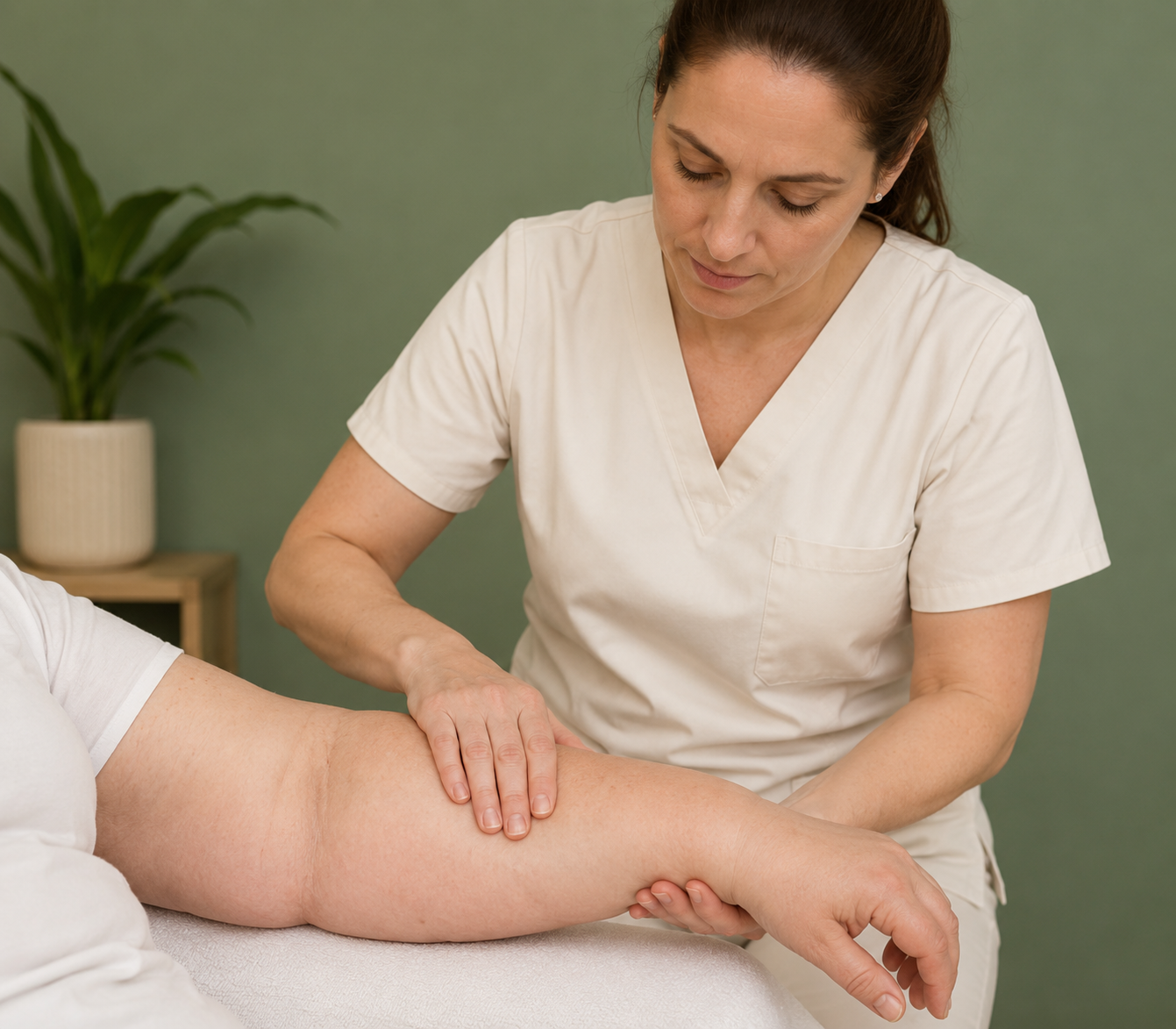
In most first sessions, your therapist will begin Manual Lymphatic Drainage — often called MLD. This is a specialized, light-touch hands-on technique that stimulates the lymphatic system to move fluid away from congested areas and redirect it toward functioning lymph nodes and vessels.
MLD is not a deep tissue massage. The pressure is very gentle — lighter than you might expect — and the movements follow specific anatomical pathways in the lymphatic system. Most patients find it deeply relaxing. It should not cause pain. If anything feels uncomfortable, tell your therapist immediately.
A full MLD session typically lasts 45 to 60 minutes, depending on the area being treated and the complexity of your condition. In a first session, the MLD component may be shorter to allow time for assessment and education.
Compression
Compression is a core component of lymphedema treatment. Without compression, fluid that has been mobilized by MLD can re-accumulate. Your therapist will discuss compression options with you based on your stage, your limb measurements, and your daily life.
Early in treatment, compression bandaging is often used between sessions. Over time, as limb volume reduces and stabilizes, your therapist will fit you for a custom or ready-to-wear compression garment. At Thera, we provide professional compression garment assessment and fitting as part of our lymphatic care services — and we can help you understand what to look for and what to avoid when it comes to garment quality and fit.
Education and self-management
One of the most important things your therapist will do in your first session — and throughout your care — is teach you. Lymphedema is a lifelong condition that requires active self-management. The good news is that self-management is learnable, and most patients become confident in it faster than they expect.
From the first session, your therapist will begin teaching you:
- How to perform Simple Lymphatic Drainage (SLD) at home — a simplified version of MLD you can do yourself between sessions
- How to care for your skin to prevent infection, which can trigger or worsen lymphedema flares
- How to apply and manage your compression bandaging or garments
- Which activities and situations to be aware of, and how to modify your daily life to support lymphatic health
How many sessions will you need?
There is no single answer — it depends on your stage, how long the condition has been present, which area is affected, and how your body responds to treatment. That said, your therapist will give you a clear initial treatment plan at the end of your first session, including an estimated course of care.
Lymphedema treatment typically moves through two phases. The intensive phase involves frequent sessions — often multiple times per week — focused on reducing limb volume, improving tissue quality, and establishing your self-management routine. The maintenance phase follows once volume has stabilized, and involves less frequent sessions focused on sustaining your results and adjusting your home program over time.
New York State allows direct access to physical and occupational therapy for up to 10 visits or one month without a physician's referral. Many patients begin their care at Thera under direct access and obtain a referral for ongoing treatment once they have connected with a physician for formal diagnosis and long-term management planning. Your therapist can help you understand your options.
What does treatment feel like — and what should you feel afterward?
Most patients leave their first session feeling lighter in the treated limb — both literally and figuratively. The relief of finally having someone assess the condition carefully, explain what is happening, and begin doing something about it is significant. Many patients tell us that the first session was much less intimidating than they anticipated.
Some temporary fatigue is normal after MLD, particularly in early sessions. This is your lymphatic system doing real work. Drinking plenty of water after your session supports that process. Any significant discomfort, worsening of symptoms, or unusual reactions should be reported to your therapist before your next visit.
Lymphedema treatment at Thera in NYC
At Thera Physical and Occupational Therapy, our Certified Lymphedema Therapists provide individualized evaluation and treatment for lymphedema at every stage — from subclinical risk through complex, chronic presentations. We treat lymphedema following breast cancer surgery and radiation, after other cancer treatments, in patients with primary lymphedema, and in those with combined lipolymphedema. Our team includes both physical and occupational therapists trained in the full CDT protocol, compression garment fitting, and long-term self-management education.
Our clinic is located at 115 West 30th Street in Midtown Manhattan, steps from Penn Station and accessible from across the Tri-State Area. Sessions are always one-on-one — your therapist's attention is never divided.
If you are ready to understand what is happening in your body and take the first step toward managing it, contact our team today to schedule your evaluation.
Your first lymphedema treatment session is an evaluation, a conversation, and the beginning of a plan — not something to approach with apprehension. A Certified Lymphedema Therapist will assess your condition carefully, take precise measurements, begin Manual Lymphatic Drainage, and start teaching you how to manage your lymphedema at home. Most patients leave their first session with a clearer understanding of their condition and more confidence than they arrived with. If you have been putting off making that first call, this is your sign to make it.
If you are experiencing swelling, heaviness, or changes in a limb after cancer treatment or surgery — or if you have already been diagnosed with lymphedema and are looking for specialized care in New York City — contact our team today to schedule an evaluation at our Midtown Manhattan clinic.
No referral needed · New York State allows direct access to physical and occupational therapy for up to 10 visits or one month without a physician's script.