
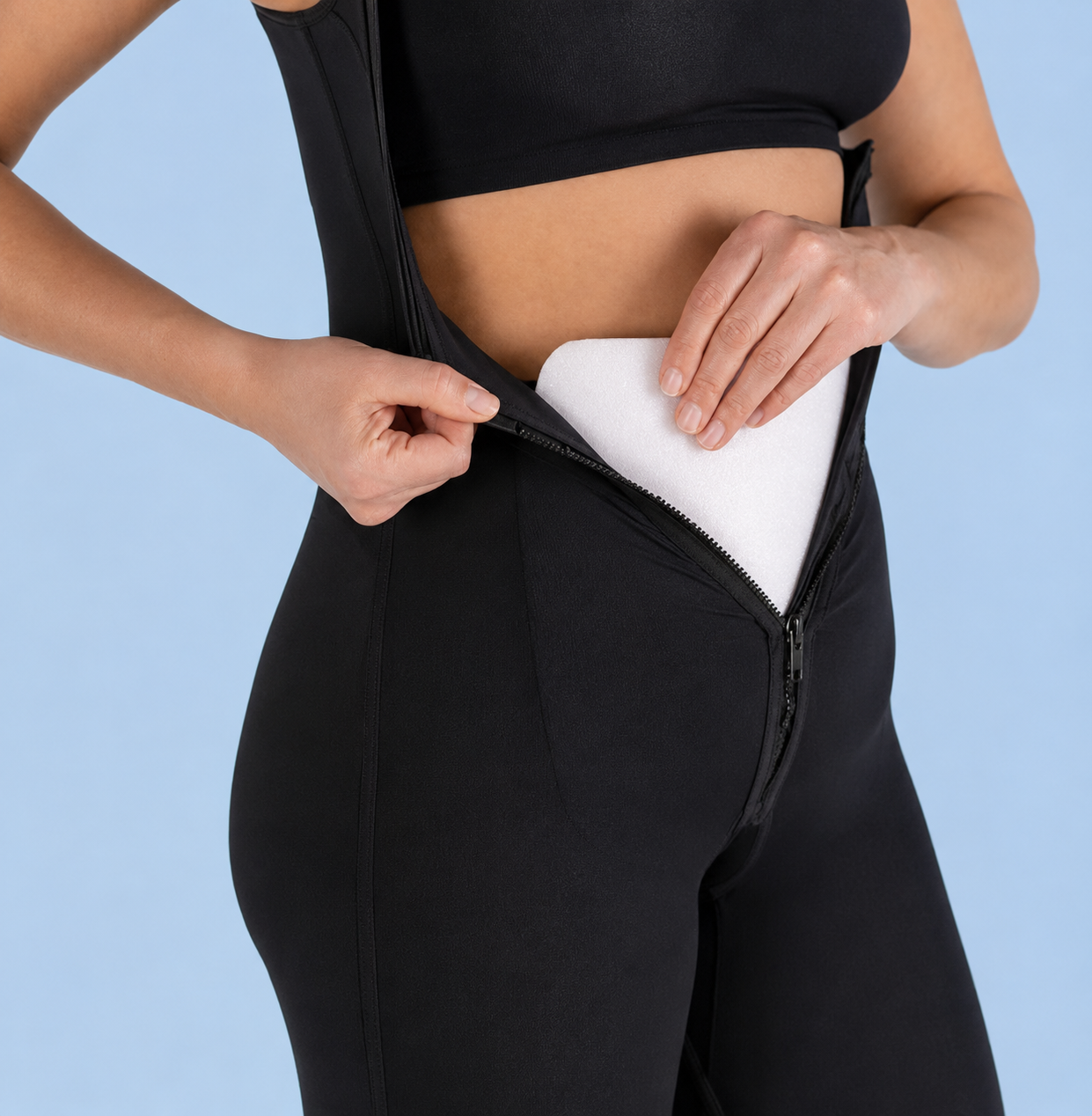
If you have had liposuction, a tummy tuck, a BBL, or another body-contouring procedure, your surgeon likely sent you home with a compression garment — and possibly also a sheet of thin, flexible foam to wear underneath it. If you are like many patients, the foam came with minimal explanation: put it under the garment, keep it there. What it is, what it does, and why it matters for your results may never have been explained at all.
Lipo foam is not a generic cushioning material. Used correctly, it is a therapeutically active component of post-surgical recovery that evens out the pressure from your compression garment, reduces the risk of fibrosis and uneven contour, supports fluid drainage, and helps the skin adhere smoothly to its new underlying structures. Used incorrectly — or not used at all — it leaves gaps in your recovery that can show up weeks or months later as firmness, lumps, or irregular texture beneath the skin.
At Thera Physical and Occupational Therapy in Midtown Manhattan, our Certified Cosmetic Surgery Therapists (CCSTs) and Certified Lymphedema Therapists (CLTs) guide patients through post-surgical recovery after liposuction, tummy tuck, BBL, and other body-contouring procedures. This guide explains what lipo foam is, how it works, and how to use it correctly.
What lipo foam is
Lipo foam — also called post-surgical foam, abdominal foam board, or compression foam — is a thin sheet of medical-grade, hypoallergenic open-cell foam designed to be worn directly against the skin, beneath a compression garment, after liposuction or other body-contouring surgery. It is typically available in flat sheets that can be trimmed to fit specific body areas, or in pre-shaped abdominal boards contoured to the typical anatomy of the treated zone.
It is not the same as the foam padding used in lymphedema bandaging (which is applied beneath compression bandages to a swollen limb) — though the underlying mechanical principles are related. Post-surgical lipo foam is flatter, more flexible, and designed to be worn comfortably beneath a compression garment during recovery rather than as part of a therapeutic bandage system.
What lipo foam does — and why a compression garment alone is not enough
Creates uniform pressure over treated areas
A compression garment provides overall compression to the treated region — but it does not contact the body's surface evenly. The body has natural curves, hollows, and contour changes, and a compression garment that fits the general shape of the abdomen or flanks will not apply equal pressure across every point of that surface. Areas of recessed contour — where the garment is bridging a hollow rather than pressing against tissue — receive little to no meaningful compression. Areas over bony prominences may receive excessive focal pressure.
Lipo foam fills the gap between the garment and the skin, creating a more uniform interface. The result is that compression from the outer garment is transmitted evenly across the entire treated zone — which is what effective post-surgical compression requires.
Reduces fibrosis risk
Fibrosis — the formation of fibrous connective tissue deposits in the healing surgical zone — is one of the most common complications of liposuction and body-contouring surgery. It develops when fluid stagnates in the disrupted tissue, creating a chronic inflammatory environment in which the body over-produces collagen. Areas of the treated zone that are under-compressed are most susceptible to fibrosis, because inadequate compression allows fluid to accumulate in those areas.
Lipo foam, by ensuring that even pressure reaches all areas of the surgical zone, directly reduces the pockets of under-compression that are the primary sites of fibrosis development. This is the most clinically important role of lipo foam in recovery — and it is one that most patients do not understand until they are already dealing with established fibrosis that could have been prevented. Learn more about fibrosis after liposuction and how it is treated.
Supports skin adherence and smooth contour
After liposuction, the skin needs to adhere to the underlying tissue as it heals. This adherence process — sometimes called "skin retraction" — is influenced by the consistency and evenness of the pressure applied during recovery. Uniform compression from lipo foam beneath the garment supports smooth, even adherence, reducing the risk of skin that settles unevenly, appears dimpled, or feels tethered in localized areas.
Reduces bruising and swelling
Compression that reaches the skin surface evenly is more effective at limiting fluid accumulation in the immediate post-surgical period. Lipo foam, by improving the contact between the garment and the skin, amplifies the anti-edema effect of the compression garment — reducing the volume of swelling and bruising in the early weeks of recovery.
Provides comfort during recovery
Compression garments, particularly in the early weeks of recovery when the tissue is acutely tender, can feel harsh against sensitive post-surgical skin. Lipo foam provides a soft, conforming buffer between the skin and the garment — protecting the skin from friction, distributing the garment's pressure away from the most sensitive areas, and making the garment significantly more tolerable to wear consistently. Garment compliance — actually wearing the garment for the hours your surgeon recommends — is directly related to comfort. Anything that improves comfort improves compliance, and improved compliance improves outcomes.
How to use lipo foam correctly
Placement
Lipo foam is placed directly against the skin, beneath the compression garment — not over the garment. It should cover the treated area evenly, including the flanks and any areas of the back that were treated if you had circumferential liposuction. If foam sheets are used, trim them to cover the treated zone without overlapping significantly at the edges, which can create pressure ridges.
Smoothing
Before putting on the compression garment over the foam, ensure the foam is completely smooth and flat against your skin. Any wrinkle or fold in the foam will create a linear pressure point on the skin beneath the garment — which can cause a pressure mark or, over time, a linear area of different healing from the surrounding tissue. Smooth out the foam carefully before securing the garment.
Duration
Follow your surgeon's guidance on how long to wear the foam each day. In most protocols, lipo foam is worn during all the hours you are wearing your compression garment — which in the early post-surgical period is typically twenty-two to twenty-three hours per day. It is removed for bathing and garment changes. As recovery progresses and the garment wear time decreases, foam use typically decreases proportionally.
Replacement
Lipo foam sheets are generally considered single-use or short-term-use items. They compress and lose structural integrity over time. Replace your foam when it no longer feels resilient under the garment, when it has developed tears or thinning areas, or when your therapist advises. Many patients benefit from having four to six sheets on hand during the recovery period.
When professional guidance makes a difference
For straightforward recoveries with limited treated areas, the standard instructions from your surgeon for using lipo foam are usually sufficient. For patients with more extensive procedures — circumferential 360-degree liposuction, combined tummy tuck and liposuction, or BBL — or for those who have developed early fibrosis or uneven contour, the guidance of a CCST or CLT makes a meaningful clinical difference.
At Thera, we assess how the foam and compression garment are functioning together as part of your recovery evaluation. We can identify areas that are under-compressed, advise on foam trimming and placement for your specific anatomy, integrate foam use with Manual Lymphatic Drainage and targeted soft tissue work, and adjust the approach as your recovery progresses. If you are already dealing with firmness or irregular texture, we will also advise on whether foam modification can be part of the treatment approach alongside our post-surgical rehabilitation.
Contact our team today to schedule an evaluation if you have questions about your recovery or want clinical support for the foam and compression phase of your healing.
Lipo foam is a therapeutically active component of post-surgical recovery after liposuction and body-contouring surgery — not an optional accessory. By evening out the pressure from your compression garment, it reduces fibrosis risk, supports skin adherence, limits bruising and swelling, and improves the tolerability of compression during recovery. Using it correctly, smoothly applied beneath your garment during all garment-wearing hours, is one of the most straightforward things you can do to protect your surgical results.
If you are recovering from liposuction, a tummy tuck, or another body-contouring procedure and want professional guidance on your compression and foam protocol, contact our team today to schedule an evaluation at our Midtown Manhattan clinic.
No referral needed · New York State allows direct access to physical and occupational therapy for up to 10 visits or one month without a physician's script.