
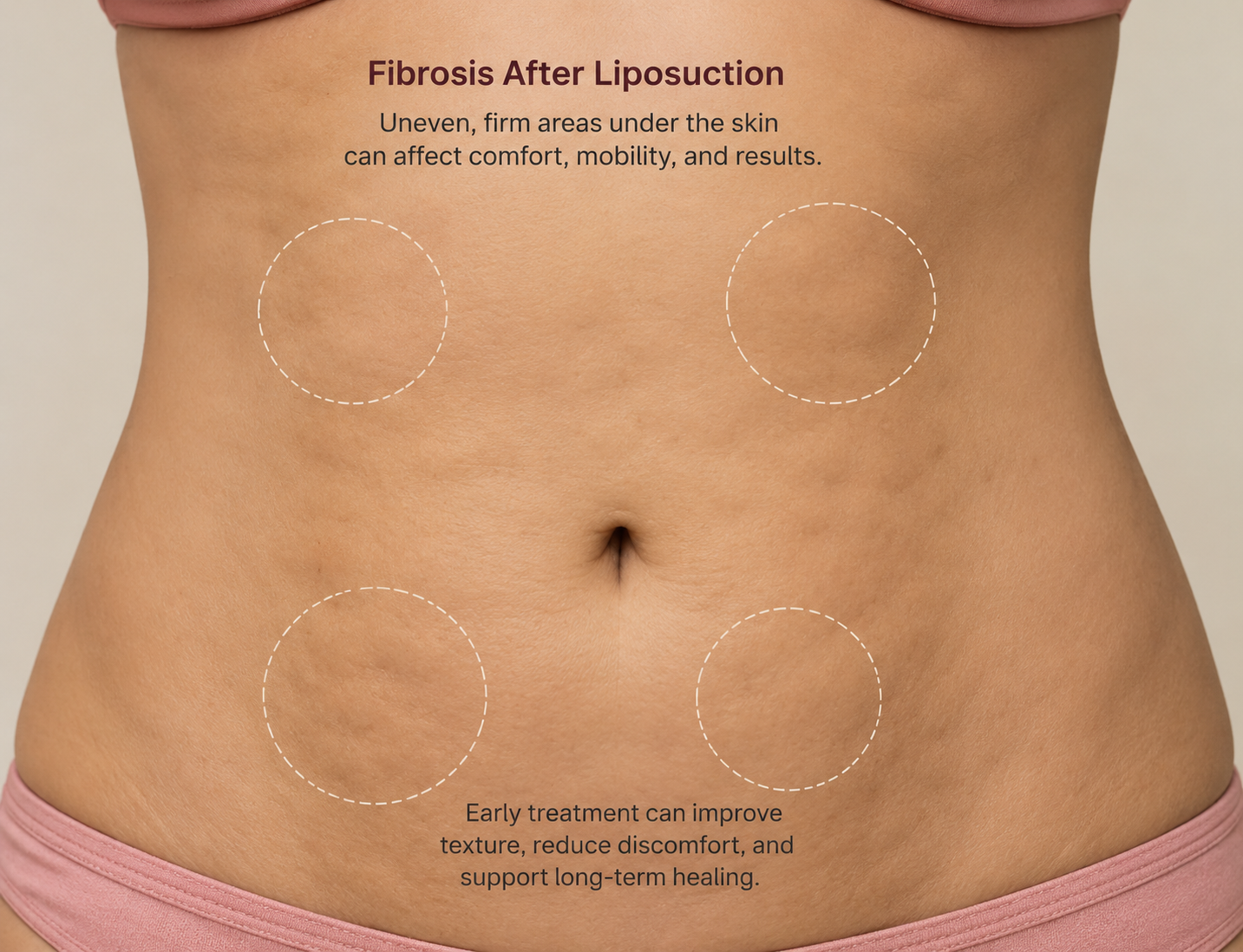
You had liposuction. The swelling in the first few weeks was expected — your surgeon told you about that. But now, weeks into recovery, something feels different from ordinary swelling. There are areas that feel hard, almost like firm ridges or dense patches beneath the skin. The texture is uneven. When you press on it, it does not give the way soft tissue should. It may be tender. And it is not going away.
What you are likely dealing with is fibrosis — a common complication of liposuction that develops when the body's healing response produces excess fibrous connective tissue in the treated area. It is not a sign that your surgery went wrong, and it does not mean your results are ruined. But it does need to be treated — and the sooner treatment begins, the more fully it resolves.
At Thera Physical and Occupational Therapy in Midtown Manhattan, our Certified Cosmetic Surgery Therapists (CCSTs) and Certified Lymphedema Therapists (CLTs) specialize in post-surgical fibrosis treatment — the clinical manual work that breaks down fibrous tissue, restores tissue mobility, and supports the smooth final result your liposuction was meant to achieve. This guide explains what fibrosis actually is, why it forms, what it feels like, and how it is treated.
What fibrosis after liposuction actually is
Liposuction removes fat by inserting a thin cannula — a narrow tube — beneath the skin and using suction to extract fat cells from the surrounding tissue. This process is inherently disruptive: the cannula creates micro-trauma in the tissue as it moves through it, damaging fat cells, blood vessels, and the lymphatic capillaries running through the treated area. The body responds to this trauma the same way it responds to any injury: with inflammation, fluid accumulation, and ultimately, the production of new connective tissue to repair the damage.
In a well-managed recovery, that repair process produces smooth, healthy healing. When the inflammatory response is prolonged — because lymphatic drainage is disrupted, fluid is not moving efficiently, or compression and early manual care are insufficient — the body over-produces collagen and fibrous connective tissue in the treated zone. That excess tissue accumulates in disorganized bands and deposits beneath the skin, creating the characteristic firmness, lumps, and irregular texture of post-liposuction fibrosis.
Fibrosis typically becomes apparent between two and six weeks after liposuction, once initial swelling begins to subside and the underlying tissue changes become palpable. It is not the same as ordinary post-surgical swelling, and it does not resolve on its own the way swelling does. Left untreated, fibrous tissue can harden further and become progressively more resistant to conservative treatment over time.
How to recognize it: what fibrosis feels and looks like
Not every area of firmness after liposuction is fibrosis — some tightness and density in the first few weeks of healing is a normal part of recovery. The distinction matters, because ordinary post-surgical swelling does not require intervention beyond compression and time, whereas fibrosis does.
- Hardness or density in the treated area that persists beyond four to six weeks, after early swelling has largely resolved
- Palpable ridges, bands, or cord-like structures beneath the skin surface
- Uneven or lumpy skin texture — areas that feel smooth next to areas that feel irregular or raised
- Tissue that does not compress or "give" under light pressure the way surrounding soft tissue does
- Tenderness or aching in the firm areas, particularly with pressure or movement
- Skin that appears tethered or dimpled — pulled downward in localized areas — due to adhesions between the skin and deeper tissue layers
- Areas that feel different in character from typical swelling: denser, more localized, and not responsive to elevation or rest
If you are noticing these changes, the most useful next step is a clinical assessment — not because the situation is alarming, but because fibrosis responds to treatment differently depending on how established it is, and a trained therapist can assess the tissue, confirm what is happening, and begin appropriate treatment right away.
Why fibrosis forms — and what makes some patients more susceptible
Fibrosis after liposuction is not caused by surgical error alone. Several factors contribute to how much fibrous tissue forms and how dense it becomes — some related to the procedure, some to the healing environment, and some to the individual patient.
Disruption of the lymphatic system
The lymphatic capillaries running through fatty tissue are inevitably disrupted by the cannula during liposuction. When lymphatic flow is compromised, protein-rich fluid accumulates in the treated area. That stagnant fluid — if not cleared efficiently through lymphatic drainage — creates the chronic inflammatory environment in which excess fibrous tissue forms. This is one of the most important reasons that early Manual Lymphatic Drainage (MLD) is not simply a comfort measure after liposuction: it directly interrupts the mechanism by which fibrosis develops.
Delayed or insufficient lymphatic drainage
Patients who delay lymphatic drainage after liposuction, or who do not receive enough sessions during the critical early weeks of recovery, are at significantly higher risk of developing fibrosis. The lymphatic vessels begin regenerating after surgery, but they need support — both to clear the existing fluid and to re-establish functional drainage patterns. Missing that early window allows fluid stagnation and fibrous tissue deposition to become entrenched before intervention begins.
Inadequate compression
Compression garments serve multiple purposes in liposuction recovery. They reduce fluid accumulation, support the tissue as it adheres to its new underlying contours, and provide the external pressure that discourages disorganized fibrous tissue formation. Patients who do not wear their garments consistently — or who use garments that are incorrectly fitted — lose this protective effect and are more likely to develop fibrosis in undertreated areas.
Higher-volume or more extensive procedures
The more tissue that is traumatized during surgery, the greater the inflammatory response and the more robust the healing reaction. Patients who have had high-volume liposuction, or procedures covering large areas — such as circumferential 360-degree liposuction — are at higher risk for fibrosis than those who had more limited procedures. Combined procedures, such as a tummy tuck with liposuction, similarly involve more tissue disruption and require more intensive post-surgical management.
Individual healing factors
Some patients are genetically predisposed to produce more fibrous tissue in response to injury. Age, skin quality, overall health, and how well the body mounts and resolves inflammatory responses all influence how much fibrosis develops after a given procedure. These factors are not controllable, but they make the case for early professional intervention even stronger for patients who know they tend toward difficult healing.
How fibrosis after liposuction is treated
The good news about post-liposuction fibrosis is that it responds well to clinical treatment — particularly when addressed in the weeks and months following surgery, before the fibrous tissue has fully matured and hardened. Treatment at Thera combines several techniques, applied in an individualized sequence based on the character, location, and age of the fibrotic tissue.
Manual Lymphatic Drainage (MLD)
MLD is the foundation of fibrosis treatment after liposuction. Even when fibrosis has already formed, there is typically ongoing lymphatic disruption in the surrounding tissue that continues to feed the inflammatory environment. MLD addresses this directly — stimulating the lymphatic system to clear residual fluid and cellular debris, reducing the chronic low-grade inflammation that drives further fibrotic deposition, and improving the microcirculatory environment in which fibrous tissue softens and remodels.
MLD also prepares the tissue for the more targeted manual work that follows. A congested, swollen tissue environment is more resistant to soft tissue mobilization; a tissue that has been drained and decompressed responds more readily to deeper work.
Manual soft tissue mobilization and scar work
Once lymphatic drainage has prepared the tissue, your therapist will apply targeted manual techniques to the fibrotic areas themselves. These techniques — which draw on the principles of scar mobilization and soft tissue release — work directly on the fibrous bands and adhesions, using precise, graded pressure to mechanically disrupt the collagen organization, restore mobility between tissue layers, and encourage the fibrous tissue to remodel toward a softer, more pliable structure.
This is distinct from general massage. The techniques used are specific to the nature of fibrous scar tissue — applied at the correct depth, in the correct direction, and with the correct pressure to be effective without damaging healing tissue. A CCST at Thera is trained specifically in post-surgical tissue assessment and the manual treatment of fibrosis, which requires a different skill set from general massage therapy.
Compression guidance
Compression remains important even after fibrosis has formed. Your therapist will assess whether your current garment is providing appropriate, even pressure across the treated areas — and whether foam inserts, padding, or a different garment type would better support fibrosis treatment by maintaining pressure in areas where the garment may not fit perfectly against the tissue's surface. Consistent, correctly applied compression between sessions significantly enhances treatment outcomes.
Patient education and home care
Your therapist will teach you simple lymphatic self-drainage techniques you can perform at home between sessions, as well as guidance on how to maintain your compression garment and which activities and habits support — or hinder — fibrosis resolution. Understanding your own recovery empowers you to actively support the process rather than simply waiting for the next appointment.
When to start treatment — and what happens if you wait
The optimal window for fibrosis treatment is as early as possible — ideally within the first four to eight weeks after liposuction, coordinated with your surgeon's clearance for manual work in the treated area. During this window, the fibrous tissue is still relatively immature and responds readily to manual treatment. Most patients who begin treatment in this phase see meaningful softening and improvement within a series of sessions.
Fibrosis that is left untreated through the first few months of recovery becomes progressively more mature and dense. Older, established fibrosis requires more intensive treatment over a longer course and achieves less complete resolution than tissue that was addressed early. This does not mean treatment is futile for patients who come in later — meaningful improvement is still achievable — but the clinical reality is that starting earlier consistently produces better outcomes.
If you had liposuction more than six months ago and are still dealing with firmness, uneven texture, or restricted areas, it is not too late to seek care. We work with patients at every stage of post-liposuction recovery, including those dealing with fibrosis that was never treated in the early months. The tissue will still respond — it simply requires a more persistent and targeted approach.
Post-liposuction fibrosis treatment at Thera in NYC
At Thera Physical and Occupational Therapy, post-liposuction fibrosis treatment is delivered by therapists who hold both the Certified Cosmetic Surgery Therapist (CCST) and Certified Lymphedema Therapist (CLT) credentials. This dual training is what makes the clinical difference: understanding the lymphatic anatomy of post-surgical tissue, the mechanics of scar tissue formation and remodeling, and how to sequence MLD with targeted manual soft tissue work to produce the best outcome for each patient's specific presentation.
We work closely with plastic surgeons across the New York area and are experienced in coordinating care with your surgical team to ensure that treatment timing and technique are appropriate for your specific procedure and recovery stage. Our clinic is located at 115 West 30th Street in Midtown Manhattan, steps from Penn Station and accessible from across the Tri-State Area. Every session is one-on-one — your therapist's attention is never divided.
Whether you are a few weeks out from liposuction and want to get ahead of fibrosis before it establishes, or you are months out and dealing with firmness that was never properly addressed, contact our team today to schedule an evaluation at our Midtown Manhattan clinic.
Fibrosis after liposuction is common, treatable, and significantly more responsive to clinical intervention when addressed early. The hardness, lumps, and uneven texture it produces are not inevitable permanent outcomes — they are the result of a healing process that can be guided and redirected with the right clinical care. Manual Lymphatic Drainage, targeted soft tissue mobilization, and compression support, delivered by a therapist with post-surgical and lymphatic training, can produce meaningful and lasting improvement. If something feels harder or more irregular than it should this far into your recovery, that is worth addressing — and the right time to start is now.
If you are dealing with firmness, lumps, or uneven texture after liposuction — or if you want to prevent fibrosis from forming in the first place — contact our team today to schedule an evaluation at our Midtown Manhattan clinic.
No referral needed · New York State allows direct access to physical and occupational therapy for up to 10 visits or one month without a physician's script.