
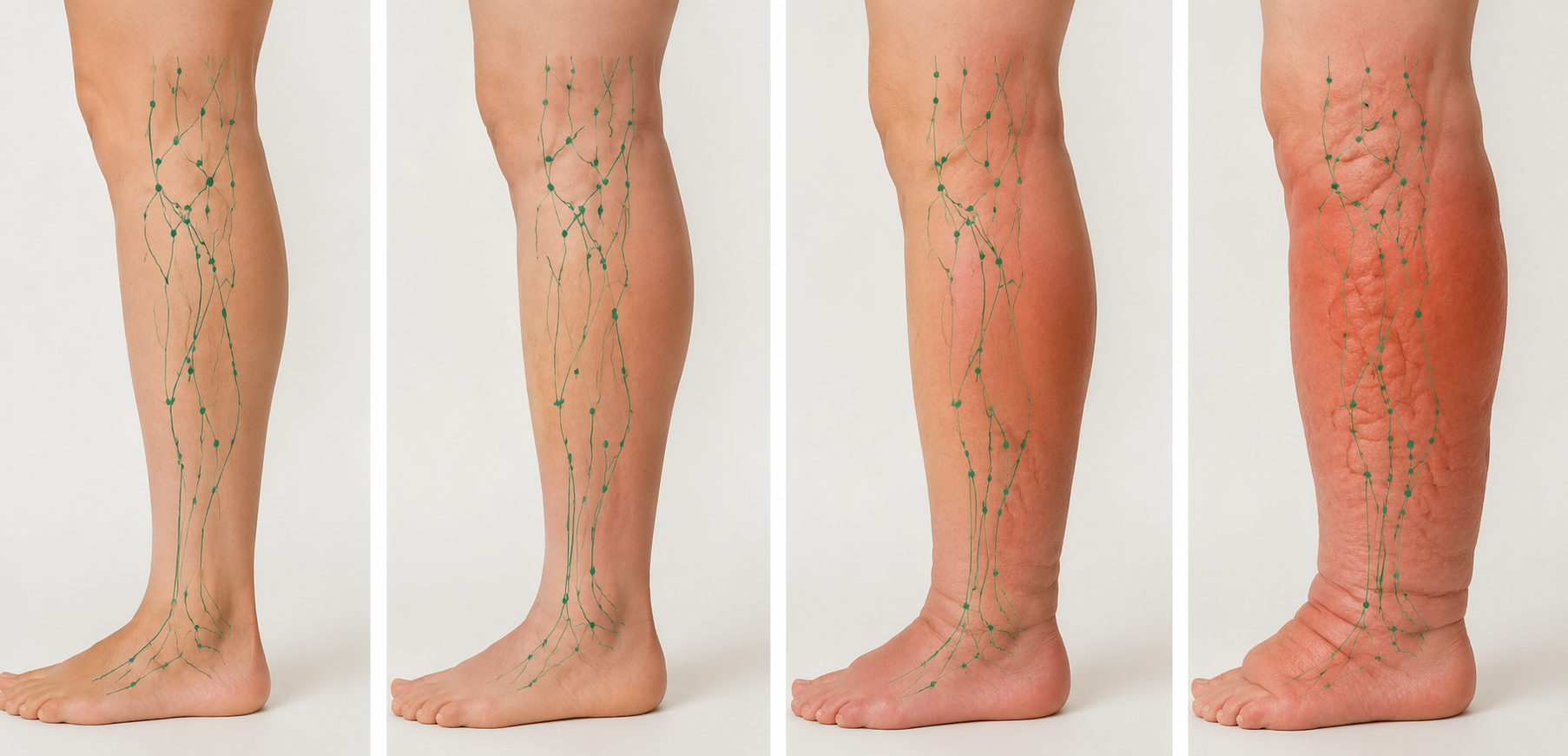
If you have been told you have lymphedema — or that you are at risk for it — you may have heard the word "staging" used without a clear explanation of what it means. Lymphedema staging is not simply a measure of how bad the swelling is. It describes the structural state of the affected tissue, the reversibility of the condition at its current presentation, and — most importantly — what treatment can realistically achieve.
Understanding your stage gives you a clearer picture of where you are, what the trajectory looks like without treatment, and why starting care sooner consistently produces better outcomes than waiting. At Thera Physical and Occupational Therapy in Midtown Manhattan, our Certified Lymphedema Therapists (CLTs) assess staging at every patient's first evaluation and use it to guide every treatment decision that follows.
This post explains the International Society of Lymphology (ISL) staging system — the clinical standard — including the often-missed Stage 0, which is where early intervention makes the greatest difference.
Why staging matters: tissue changes, not just fluid
Lymphedema begins as a fluid problem — the lymphatic system's capacity to drain tissue fluid is reduced, and fluid accumulates in the interstitial space. In the early stages, this is primarily a fluid excess. In later stages, it becomes something more complicated: the chronic inflammatory environment created by stagnant, protein-rich lymph triggers a biological repair response that deposits fibrous connective tissue in the affected region. As fibrosis accumulates, the tissue changes structurally — becoming firmer, less pliable, and progressively less responsive to treatment.
This transition from fluid excess to tissue change is what the staging system captures. Early stages are characterized primarily by fluid. Later stages are characterized by fluid combined with — and eventually dominated by — structural tissue change. Treatment that is highly effective at Stage 0 and Stage 1 becomes more intensive and yields less complete results at Stage 3, because reversing established fibrosis is clinically harder than preventing it.
Stage 0 — Subclinical lymphedema (latent stage)
Stage 0 is the most important stage that most patients never hear about. At Stage 0, the lymphatic system has been damaged or compromised — by surgery, radiation, infection, or trauma — but the body's remaining lymphatic capacity is still sufficient to compensate. No visible or measurable swelling is present. The limb looks and measures normal.
What is present at Stage 0 is reduced reserve. The lymphatic system is working harder than it should to maintain normal fluid balance, and any additional stress — heat, prolonged activity, injury, infection — can push it past its compensatory capacity and trigger visible swelling. Patients at Stage 0 may notice subjective changes: a sense of heaviness, fullness, or fatigue in the limb that was not there before their surgery or treatment. These symptoms are real, even when measurements are still within normal range.
Stage 0 may persist for months or years before progressing — or it may never progress to visible swelling if the lymphatic system continues to compensate and appropriate precautions are maintained. This is the window where intervention is most powerful: establishing a baseline measurement record, educating patients on precautions and self-care, monitoring for changes, and beginning conservative management immediately if any shift is detected. Learn more about our approach to lymphedema prevention and monitoring at Thera.
Stage 1 — Reversible lymphedema
At Stage 1, visible and measurable swelling is present — but the tissue changes are still primarily fluid-based. The key distinguishing feature of Stage 1 is that the swelling reduces with elevation. If the patient elevates the limb overnight, the swelling diminishes — sometimes significantly — by morning. This reversibility is the hallmark of Stage 1 and reflects the fact that the tissue has not yet undergone significant structural change. The excess is fluid, not fibrosis.
Pitting edema — the ability to press a finger into the swollen tissue and leave an indentation that fills slowly — is typically present at Stage 1, particularly in the early part of the stage. The tissue feels soft and compressible. The skin is not yet thickened or significantly altered in texture.
What treatment looks like at Stage 1: Complete Decongestive Therapy is highly effective at Stage 1. The intensive phase of CDT — with daily or near-daily sessions of Manual Lymphatic Drainage, multi-layer short-stretch bandaging, therapeutic exercise, and skin care — consistently produces significant volume reduction. Most patients whose lymphedema is identified and treated at Stage 1 achieve excellent long-term volume control and can maintain their limb with compression garments and a well-learned home management routine. The word "reversible" in the stage name reflects the clinical reality: with proper treatment, Stage 1 lymphedema can be brought under control in a way that later stages cannot.
Stage 2 — Spontaneously irreversible lymphedema
Stage 2 represents a fundamental shift in the nature of the condition. The defining feature is that the swelling no longer reduces with elevation alone. Overnight elevation does not bring the limb back to normal volume the way it did at Stage 1. This is because fibrotic tissue has begun to accumulate — the chronic inflammatory environment of the stagnant lymph has triggered fibroblast activation and collagen deposition in the tissue, creating structural changes that are not reversible simply by removing gravity from the equation.
The tissue at Stage 2 feels firmer than in Stage 1. There may be areas of hardness or reduced compressibility. The Stemmer sign — the inability to pinch and lift the skin at the base of the second toe (for lower extremity lymphedema) or the second finger (for upper extremity) — may become positive. Skin texture may begin to change. Pitting edema may still be present in areas where the excess is still primarily fluid, but non-pitting firmness is also emerging in areas where fibrosis has established.
Stage 2 is also split clinically into early and late presentations. Early Stage 2 still has meaningful fluid excess alongside beginning fibrosis and responds well to CDT with consistent volume reduction. Late Stage 2 has more established fibrosis, requires more intensive and targeted manual treatment, and achieves less dramatic volume reduction — though significant functional improvement is still consistently achievable.
What treatment looks like at Stage 2: CDT remains the gold standard and produces meaningful improvement. The intensive phase is typically longer and more demanding than at Stage 1. MLD sessions target both the fluid excess and the fibrotic tissue — working to soften adhesions and improve tissue mobility alongside driving lymphatic flow. Compression garment selection becomes more critical, as irregular tissue contour may require custom flat-knit garments rather than standard circular-knit. Manual soft tissue mobilization addressing the fibrotic tissue becomes a more prominent component of treatment.
Stage 3 — Lymphostatic elephantiasis
Stage 3 is the most advanced classification and reflects extensive structural changes in the affected tissue. The defining features are severe volume increase, absent pitting (the tissue is too fibrotic to pit), and significant skin and tissue changes — including hyperkeratosis (thickened, warty skin texture), papillomatosis (small outgrowths of skin tissue), and skin folds created by large lobular fat hypertrophy. The tissue is no longer primarily fluid — it is dominated by fibrosis and fat deposition that has occurred in response to years of lymphatic impairment.
Functional impairment at Stage 3 is significant. Large tissue volumes alter gait, limit joint mobility, and create conditions that increase infection risk — particularly recurrent cellulitis, which can further damage lymphatic vessels and accelerate progression. Skin integrity is a primary management priority.
What treatment looks like at Stage 3: CDT at Stage 3 is intensive and long-term. The goals shift somewhat — rather than restoring near-normal volume, the priorities are reducing to the most functional volume achievable, preventing infection and skin breakdown, slowing further progression, and maintaining quality of life. Compression at Stage 3 is almost always custom flat-knit, often combined with foam and padding to manage the irregular contour. Some patients at Stage 3 may be candidates for surgical intervention — lymphovenous anastomosis, vascularized lymph node transfer, or debulking procedures — which are discussed with a specialist surgeon and typically followed by CDT during recovery.
A summary of the stages
- Stage 0 (Subclinical): Lymphatic system compromised but compensating. No visible swelling. Subjective heaviness or fullness may be present. Baseline measurement and monitoring are the primary interventions.
- Stage 1 (Reversible): Visible swelling present. Reduces with elevation. Primarily fluid — little or no fibrosis. Pitting edema. CDT highly effective; excellent long-term control achievable.
- Stage 2 (Spontaneously Irreversible): Swelling does not reduce with elevation alone. Fibrosis present alongside fluid excess. Positive Stemmer sign. CDT effective with more intensive course; custom garments often needed.
- Stage 3 (Lymphostatic Elephantiasis): Severe volume increase. No pitting — dominated by fibrosis and fat hypertrophy. Significant skin changes. CDT goals shift to functional optimization, infection prevention, and quality of life.
- Key principle: Earlier staging = more reversible tissue = better treatment outcomes. Every stage is treatable. No stage is untreatable. The difference is what treatment can achieve.
Lymphedema staging and treatment at Thera in NYC
At Thera Physical and Occupational Therapy, your CLT assesses your lymphedema staging at the first evaluation and at each subsequent session — because staging can change in response to treatment, and because treatment decisions are guided by where you are in the trajectory. We treat patients at every stage, from those who have just had a sentinel node biopsy and want to establish a baseline before any swelling appears, to those dealing with long-established, complex presentations that were never properly treated.
Our clinic is at 115 West 30th Street in Midtown Manhattan, steps from Penn Station and accessible from across the Tri-State Area. Every session is one-on-one. If you have been diagnosed with lymphedema, are at risk, or are experiencing symptoms you are not sure how to interpret, contact our team today to schedule an evaluation.
Lymphedema staging describes the structural state of the affected tissue — from the fluid excess of Stage 1 through the fibrotic, irreversible tissue changes of Stage 3. The critical insight is that Stage 0 exists: a subclinical stage where the lymphatic system is compromised but still compensating, where no visible swelling is present, and where early monitoring and self-management education can prevent Stage 1 from ever developing. Every stage of lymphedema is treatable. But early-stage lymphedema is not just more treatable — it is more reversible, requires less intensive treatment, and produces better long-term outcomes. The case for early assessment and early action is the case for understanding staging.
Whether you want to establish a baseline before surgery, have been diagnosed with lymphedema and want a staging assessment, or are experiencing symptoms you have not yet had evaluated, contact our team today to schedule an evaluation at our Midtown Manhattan clinic.
No referral needed · New York State allows direct access to physical and occupational therapy for up to 10 visits or one month without a physician's script.