
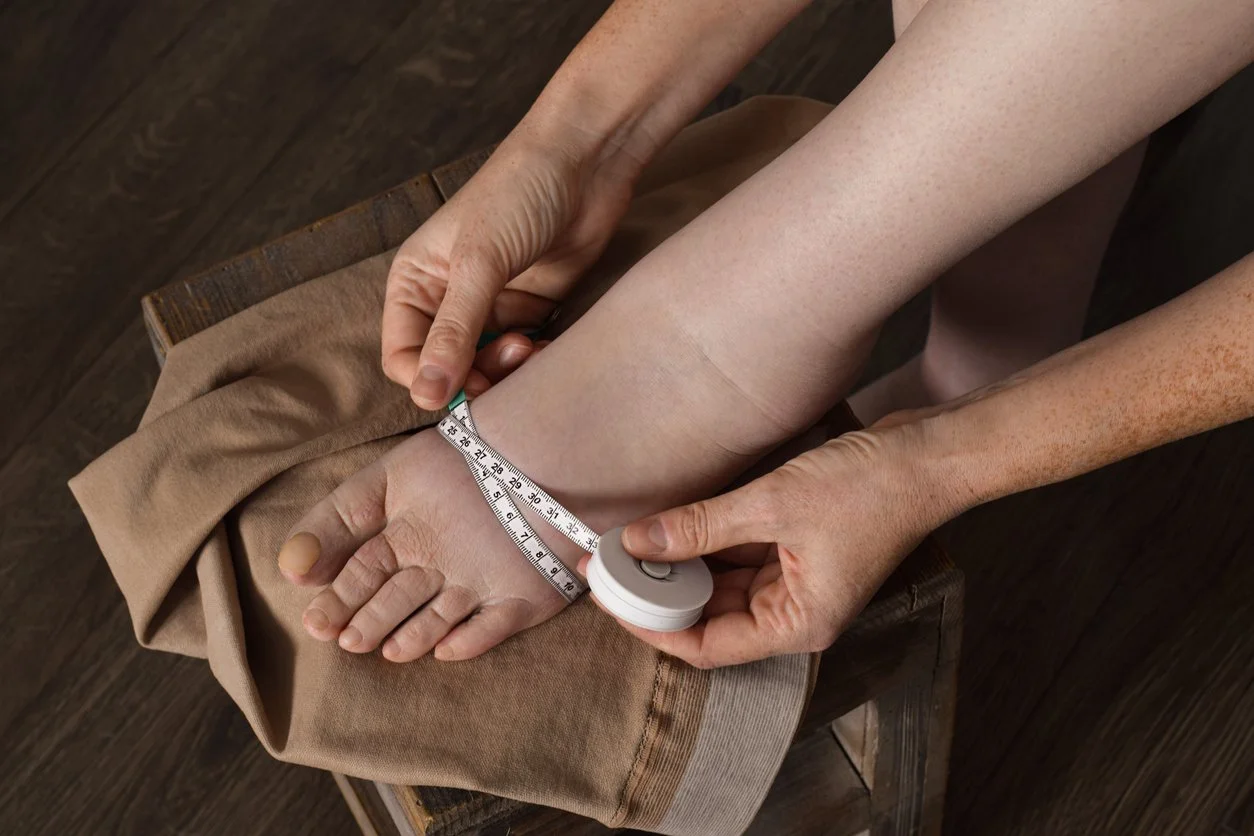
If you have had breast cancer surgery, a sentinel node biopsy, axillary lymph node dissection, or any procedure that affects the lymphatic system, you have probably been told to watch for swelling. What you may not have been told is what "watch for swelling" actually means in clinical terms — what measurements to pay attention to, what numbers are considered significant, and at what point a change in your limb warrants a call to your therapist or physician.
This question has a more complicated answer than most patients expect, because the clinical literature on lymphedema detection thresholds is genuinely unsettled. There is no single universally agreed-upon number that defines when lymphedema begins or when monitoring should escalate to active treatment. What exists is a body of evidence supporting several different measurement approaches and thresholds — each with its own clinical rationale and limitations.
At Thera Physical and Occupational Therapy in Midtown Manhattan, our Certified Lymphedema Therapists (CLTs) take baseline measurements at the start of every patient's care and monitor limb volume over time using validated techniques. This post explains what the clinical literature actually says about discrepancy thresholds, what we use in practice, and — importantly — why the numbers alone never tell the complete story.
Why this question matters — and why it is harder than it looks
Early detection of lymphedema produces dramatically better outcomes than late detection. A patient identified at Stage 0 — when the lymphatic system is compromised but no visible swelling has yet appeared — can often maintain normal limb volume with conservative management indefinitely. A patient who is not identified until Stage 2, when tissue changes have established, faces a longer, more intensive treatment course and permanent ongoing management requirements.
The challenge is that the transition from a normal limb to subclinical lymphedema is gradual, and the measurements that capture it require both precision and context. The same absolute measurement difference means something different in a large-limbed patient than in a small-limbed one. The same percentage change means something different in a patient who had a full axillary dissection versus one who had a single sentinel node biopsy. And normal biological variation — hydration, time of day, activity level, temperature — introduces measurement noise that must be accounted for before any single reading is acted upon.
This is why a published threshold is a clinical guideline, not a diagnostic line. What matters is the threshold in context — alongside symptoms, history, tissue assessment, and trend over time.
What the validated literature actually says
The clinical literature on lymphedema detection thresholds uses several different measurement approaches, and the thresholds associated with each differ. Understanding this helps explain why you may have heard different numbers from different providers.
Circumferential measurements: the 2 cm threshold
The most widely cited criterion in the published literature for circumferential measurement is a ≥2 cm interlimb difference at any single measurement point. This is the threshold identified in a systematic review published in Physical Therapy & Rehabilitation Journal (PMC3698223) as "the most common criterion" used in clinical studies, and it is referenced consistently across lymphedema research as a benchmark for diagnosis.
Your clinical training with the 3 cm threshold is also present in the literature — it is used in some clinic-specific protocols and represents a more conservative threshold, meaning it will only flag patients with more established swelling. The 2 cm criterion is more sensitive — it flags patients earlier, at the cost of potentially including some false positives due to natural bilateral variation.
Neither 2 cm nor 3 cm is "wrong." They reflect different risk tolerances: 2 cm prioritizes early detection, 3 cm prioritizes specificity. The key limitation of any single circumferential measurement is that it measures one point on the limb. A patient with diffuse lymphedema distributed across many segments may show less than 2 cm at any single point while still having a meaningful total volume difference.
Volume measurements: the 200 mL and percentage thresholds
Volume-based thresholds — calculated either from multi-point circumference measurements (using the truncated cone formula), water displacement volumetry, or optoelectric perometry — capture the total limb better than single-point circumference. The most commonly cited volume thresholds in the published literature are:
- ≥200 mL interlimb volume difference — cited as a diagnostic threshold in multiple published studies and referenced alongside the 2 cm criterion as a standard criterion (PMC3698223). Absolute volume difference is less useful in large-limbed patients, as a 200 mL difference represents a smaller proportional change in a large limb.
- ≥10% limb volume change from baseline or compared to the contralateral limb — identified in a clinical trials review as "the most accurate threshold to diagnose lymphedema" in established presentations. The International Society of Lymphology (ISL) 2020 guidelines use ≥5% as the minimal threshold and ≥20% as moderate.
- ≥5% limb volume change — increasingly favored for early detection. A clinical trials literature review (NCT03210311) notes that the 10% threshold underestimates incidence and proposes ≥5% for identifying subclinical lymphedema, while ≥3% has been proposed in some protocols as a subclinical detection threshold.
- ≥2 cm circumferential difference at any single measurement point — most commonly cited criterion in clinical research (PMC3698223). Sensitive, widely used.
- ≥3 cm circumferential difference — used in some clinical protocols; more conservative, higher specificity.
- ≥200 mL absolute volume difference — standard volumetric criterion; less useful in proportional terms for large limbs.
- ≥10% limb volume change — ISL-referenced established lymphedema threshold; moderate sensitivity for subclinical presentations.
- ≥5% limb volume change — preferred threshold for early/subclinical detection; increasingly cited in surveillance literature.
- ≥3% limb volume change — proposed in some protocols for identifying the earliest subclinical changes.
- CTCAE Grade 1: 5–10% interlimb discrepancy in volume or circumference — used in oncology clinical trial grading.
- Important caveat: A 2024 systematic review (Springer Nature / PMC11377676) states explicitly: 'parameters for detection exist but none are universally agreed upon.'
Why baseline measurement matters more than any threshold
Here is the clinical reality that every threshold discussion overlooks: a measurement compared to a known baseline is always more meaningful than a measurement compared to a population average or to the contralateral limb alone.
Natural bilateral asymmetry is common — many people have a non-dominant arm that is measurably smaller than the dominant arm, or legs that differ slightly in circumference. If a patient's right arm has always been 1.5 cm larger than the left, a 2 cm difference post-surgery may represent only 0.5 cm of new swelling — not necessarily lymphedema. Conversely, a patient whose limbs were always exactly symmetric may show clinically significant lymphedema at a 1.5 cm difference that falls below the published threshold.
This is why baseline measurement — taken before surgery, or as early as possible in the post-surgical period — is one of the most important things a CLT can do for a patient at risk for lymphedema. With a documented baseline, every subsequent measurement is compared against a known reference point for that individual. Without a baseline, all interpretation depends on population averages and contralateral limb comparison, which introduces significant ambiguity.
At Thera, we take circumferential measurements at multiple standardized points along both limbs at the initial evaluation, record them as your permanent reference baseline, and compare every subsequent measurement against both your personal baseline and the contralateral limb.
Measurement alone is not a diagnosis: the role of symptoms and tissue assessment
The clinical literature is clear on another important point: measurement thresholds are not the only criterion for diagnosis or intervention. The Common Terminology Criteria for Adverse Events (CTCAE), developed for oncology clinical trials, grades lymphedema using both objective measures (interlimb discrepancy) and subjective clinical assessments — explicitly because symptoms can be present without significant measurable discrepancy, and because significant discrepancy can exist in some patients without prominent symptoms.
In clinical practice, this means a patient who reports arm heaviness, tightness, or fatigue — even with measurements below published thresholds — deserves clinical attention. Subclinical lymphedema at Stage 0 may be detectable through tissue assessment, symptom history, and bioimpedance spectroscopy before any tape measure difference reaches 2 cm. Waiting for a measurement threshold to be crossed before intervening is waiting too long.
The correct clinical approach is: take a baseline, monitor regularly, respond to both measurement changes and symptom changes, and use your clinical assessment of tissue quality — not a single number — as the primary driver of your decision to escalate care.
What this means practically: when to seek care
If you are a patient at risk for lymphedema after breast cancer surgery, this is the practical guidance that follows from the above:
- Establish a baseline as soon as possible — ideally before surgery (prehabilitation), and certainly within the first two weeks after surgery if a pre-surgical baseline was not taken. This is the single most protective thing you can do for your ability to detect early changes.
- Report symptoms, not just measurements. Heaviness, fullness, tightness, fatigue in the arm, jewelry fitting differently — these are reasons to be assessed by a CLT regardless of what you measure at home.
- Monitor consistently over time. A single measurement is less informative than a trend. A reading that has increased from your personal baseline by 1.5 cm across two consecutive sessions is more clinically significant than a single reading of 2.1 cm with no prior context.
- Understand that different thresholds exist for different purposes. Your therapist may use 2 cm, or 3 cm, or a percentage change — depending on the measurement approach, the clinical protocol they trained in, and the specific clinical context. The threshold is a tool, not the diagnosis.
If you have not yet established a baseline measurement with a CLT — whether you are pre-surgical, recently post-surgical, or well into survivorship — scheduling an evaluation at Thera is the most actionable step you can take. Contact our team today.
The published literature on lymphedema detection thresholds uses multiple criteria — ≥2 cm circumferential difference, ≥200 mL volume difference, and ≥5–10% limb volume change are the most commonly cited — and none are universally agreed upon. Your clinical training with a 3 cm threshold is present in the literature and represents a more conservative, specific approach. What matters in clinical practice is not a single threshold but: a documented personal baseline, consistent monitoring, response to symptoms alongside measurements, and a trained therapist's hands-on tissue assessment. A number above a published threshold is a signal to act. A number below one is not permission to ignore symptoms.
Whether you are pre-surgical and want to establish a baseline, post-surgical and due for monitoring, or experiencing symptoms you are not sure how to interpret, contact our team today to schedule an evaluation at our Midtown Manhattan clinic.
No referral needed · New York State allows direct access to physical and occupational therapy for up to 10 visits or one month without a physician's script.