
You have been fitted for a compression garment. Your Certified Lymphedema Therapist has measured your limb precisely, selected the right compression class, and explained why consistent daily wear is one of the most important things you can do for your lymphedema or post-surgical recovery. And then you get home, try to put it on, and discover that donning a compression sleeve or stocking is significantly more challenging than anyone warned you about.
This is one of the most common — and most underaddressed — barriers to garment compliance. A garment that is too difficult to put on will not be worn consistently. A garment that is not worn consistently will not work. The tips, tools, and techniques in this guide are what our Certified Lymphedema Therapists at Thera Physical and Occupational Therapy in Midtown Manhattan teach our patients during the garment education component of their care. Consider this the reference guide you can come back to whenever donning feels like a struggle.
Before you start: set yourself up for success
Timing matters
Put your compression garment on in the morning, before you have been upright and active for any length of time. Swelling is lowest first thing in the morning — the result of overnight elevation and hours without gravity working against your lymphatic system. A limb that is at its lowest morning volume is significantly easier to don a garment onto than a limb that has been dependent and active for several hours. If you wait until mid-afternoon or evening, you may find the garment that slid on relatively easily in the morning has become a genuine challenge.
For patients who complete a self-drainage routine in the morning before donning, put the garment on immediately after finishing the drainage — before any rebound swelling can occur.
Skin should be clean and dry
Apply your garment to clean, completely dry skin. Lotion, oil, or cream applied to the skin before donning will make the garment slide rather than grip, and will also degrade the garment's fabric over time. If you use a moisturizer as part of your skin care routine — which is important for lymphedema-affected skin — apply it after removing the garment in the evening, not in the morning before donning. Allow it to fully absorb overnight before the garment goes back on in the morning.
The rubber gloves technique
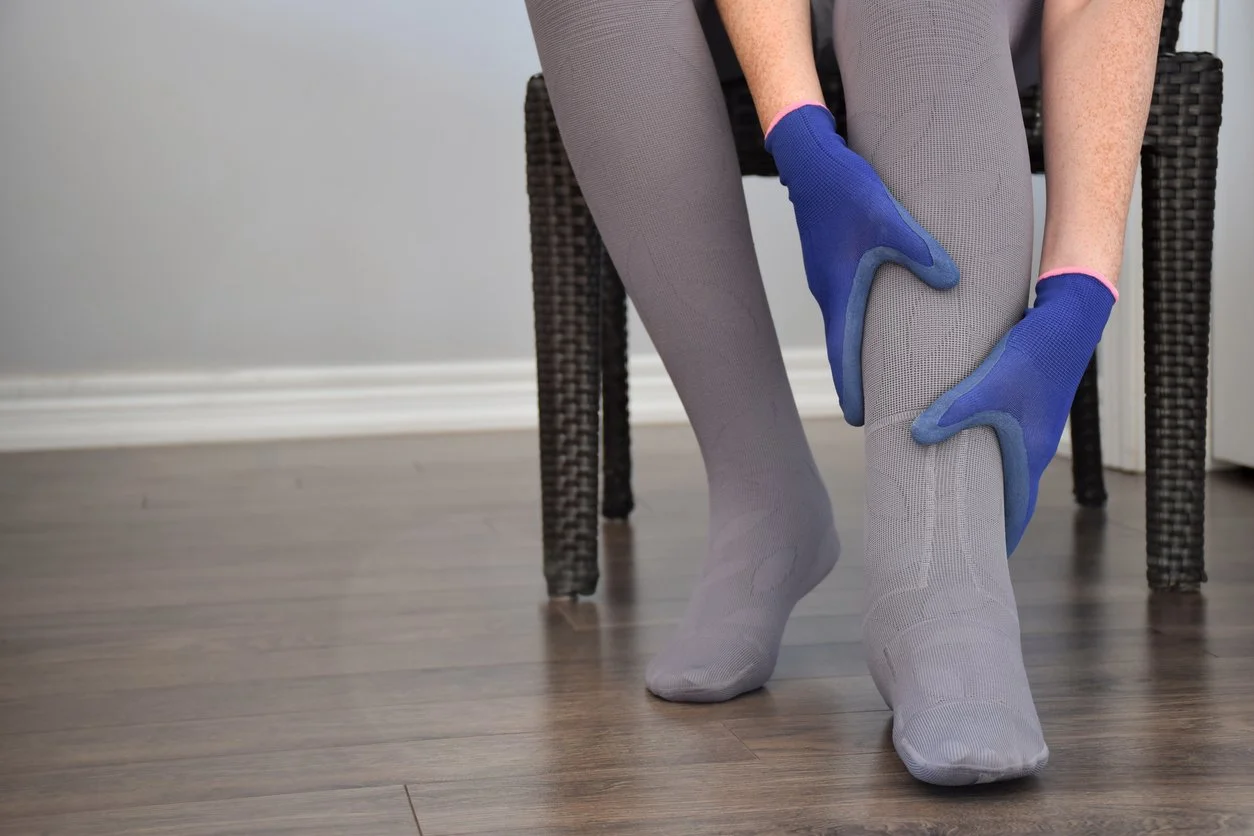
This is the single most effective technique for most patients — simple, free, and works immediately. Put on a pair of rubber or latex dishwashing gloves (or any gloves with a textured, grippy surface) before attempting to don your compression garment. The rubber provides grip between your hands and the compression fabric, which is typically slippery and resists being pulled.
With rubber gloves on, grip the garment firmly and work it up the limb using short, even strokes rather than one long pull. Smooth as you go — do not bunch and pull, which creates uneven tension and can stress the seams. The rubber gloves technique works for both arm sleeves and leg stockings and requires no special equipment.
The plastic bag (or silk liner) trick
This technique is particularly useful for leg stockings and for patients who have difficulty getting the foot into the garment correctly. Place a thin plastic bag — a clean produce bag or any thin, smooth plastic — over the foot or hand before attempting to pull the garment on. The slippery plastic surface allows the garment to slide over the skin without catching. Once the garment is in position, remove the plastic bag through the opening at the top or through the toe opening (if the garment has an open toe).
A silk or satin liner (sold by compression garment retailers specifically for this purpose) works on the same principle and is more durable than a plastic bag for daily use. Donning gloves with a smooth rather than textured surface can serve a similar function for arm sleeves.
Donning devices: what they are and when to use them
Donning aids are purpose-built tools designed to make compression garment application easier, particularly for patients with limited hand strength, grip, or dexterity — or for patients applying lower extremity garments who have difficulty bending to reach their feet.
Frame-style donning devices
Frame-style donning aids (such as the Medi Butler, the Jobst Stocking Donner, or similar devices) work by holding the garment open in a frame so you can step or slide into it without having to grip the compression fabric directly. The garment is loaded onto the frame, the limb is inserted into the opening, and the device is then used to roll or slide the garment up the limb. These are particularly useful for thigh-high and waist-high stockings where reaching the foot from a standing position is difficult.
Arm-sleeve donning aids
Arm sleeve donning aids — sometimes called arm boarding devices — hold the sleeve open while you thread the arm through it. They are less commonly needed than lower extremity aids but can be helpful for patients with significant hand or shoulder limitations.
Gutter guides
Gutter guides are smooth, curved plastic trays that you slide inside the garment to reduce friction against the skin during donning. The garment slides along the plastic surface rather than dragging against the skin. They are particularly useful for patients with fragile or sensitive skin.
Your CLT at Thera will advise on whether a donning aid is appropriate for your specific garment and situation, and can recommend specific products. Many donning devices are available through the same compression supply retailers that provide garments.
The "turning inside out" technique for stockings
For knee-high and thigh-high compression stockings, the inside-out technique is one of the most widely taught and consistently effective methods:
- Turn the stocking inside out from the top, down to approximately halfway — creating a cuff of inside-out fabric
- Place the foot of the stocking onto the foot in the correct position, ensuring the heel is properly aligned
- With rubber gloves on, gradually work the cuff of the stocking up the leg — turning it right-side-out as you go, rather than pulling it from the top
- Work in short, even upward strokes, smoothing as you go to prevent bunching
This technique works because it significantly reduces the fabric resistance at the foot — the narrowest part of the garment and usually the hardest to get into — while allowing you to control the positioning of the heel precisely before pulling the rest of the garment up.
Baby powder and corn starch: a note of caution
Baby powder and corn starch are sometimes recommended as a way to reduce friction during donning, making the garment slide on more easily. This can work — but with important caveats for lymphedema patients specifically.
Powders can accumulate in the folds of lymphedema-affected skin and in the garment fabric, and repeated use may contribute to skin irritation or dryness in tissue that is already compromised in its barrier function. If you find powder helpful, use it sparingly and wash the garment frequently to prevent buildup. Avoid using powder near any areas of broken or compromised skin.
For most patients, the rubber gloves technique or a plastic bag liner is more effective and carries no skin risk. Try those first before reaching for powder.
Smoothing and checking the fit after donning
Once the garment is on, take a moment to ensure it is correctly positioned and smooth:
- The garment should sit flat against the skin without wrinkles, folds, or rolled edges — any of these create pressure ridges that can cause skin irritation or uneven compression
- The heel of a stocking should be precisely over the heel — not riding up onto the ankle or slipping down under the foot
- The top band of the garment should not be folded down or rolled — this doubles the compression at the top edge and creates a tourniquet-like pressure point
- The garment should feel firmly supportive — not comfortable in the way loose clothing is comfortable, but without causing pain or significant discomfort. Some pressure sensation is expected; pain is not
Run your hands over the entire garment surface after donning to feel for any wrinkles or irregularities. Use rubber gloves for this step too — the grip helps you smooth the fabric more effectively than bare hands.
When donning is consistently difficult: time to reassess
If putting on your garment has become noticeably harder than it used to be — or if it was never manageable — there are two possible explanations worth investigating. First, your limb volume may have increased, meaning the garment is now too small for your current limb size and needs to be replaced or refitted. Second, the garment may be due for replacement — garments that have fatigued (lost their compression through repeated washing and wear) sometimes paradoxically become harder to put on because the fabric loses its dimensional stability.
Either situation warrants a garment reassessment at Thera. At your assessment, your CLT will re-measure your limb, evaluate your current garment's condition and fit, and advise on whether a new garment, a different style, or a donning aid would resolve the problem. Learn more about professional compression garment fitting at Thera.
Difficulty with donning should not be accepted as a permanent reality that limits how consistently you wear your garment. There is almost always a solution — and wearing the garment consistently is too important to leave that problem unsolved. Contact our team today if you are struggling with your current garment.
Consistent garment wear is one of the most important factors in lymphedema management — and difficult donning is one of the most common reasons compliance breaks down. Rubber gloves provide grip, the plastic bag technique reduces friction at the foot, inside-out application controls heel placement, and donning devices eliminate the need to reach or grip when dexterity is limited. If your garment has become noticeably harder to put on, a reassessment of your limb measurement and garment condition is worth scheduling — the problem is almost always solvable.
If you are struggling with garment donning, need a garment reassessment, or want to ensure your compression garment is working correctly, contact our team today to schedule an evaluation at our Midtown Manhattan clinic.
No referral needed · New York State allows direct access to physical and occupational therapy for up to 10 visits or one month without a physician's script.