Cupping Therapy for Scars: How It Works and the Benefits of Incorporating Cupping into Breast Rehabilitation
Author: Megan McCarthy
Cupping Therapy for Scars: How It Works
Scar tissue is a natural part of the body’s healing process. After surgery, injury, or inflammation, the body produces collagen fibers to repair damaged tissue. However, these fibers can sometimes form dense, tight adhesions that restrict movement, create discomfort, and interfere with the way tissues glide against one another.
One treatment gaining attention in rehabilitation settings is suction cup therapy, also known as cupping. When used appropriately, this technique can help mobilize scar tissue, improve circulation, and support tissue remodeling during recovery.
Cupping therapy works by creating negative pressure (suction) that lifts the skin and tissue layers upward, separating adhesions and restoring the kind of independent movement that scar tissue takes away. In a breast rehabilitation context, it is not a wellness service. It is a targeted, hands-on technique applied by trained therapists as part of an individualized treatment plan.
How Cupping Helps With Scar Tissue
Suction cup therapy works through several mechanical and physiological effects.
-
The suction gently lifts the skin, fascia, and superficial muscle layers away from deeper structures.
This lifting can help:
Reduce adhesions between tissue layers
Restore normal sliding and gliding of fascia
Improve overall tissue mobility
Instead of compressing the tissue, cupping decompresses it, which can be particularly helpful around scar tissue.
-
When suction is applied, blood flow increases to the area. Improved circulation delivers oxygen and nutrients that support tissue repair. Scar tissue gets less blood flow than healthy tissue, which is part of why it feels stiff and slow to change.
The suction created by cupping brings more circulation into the area, giving the tissue what it needs to gradually soften, flatten, and move more freely again over time.
Better circulation may help:
Promote healthier collagen remodeling
Reduce stiffness
Improve tissue elasticity
Temporary redness or discoloration may appear after treatment. This is usually the result of increased blood flow to the treated area and typically resolves on its own.
-
Swelling can contribute to scar tightness. Cupping may assist the movement of fluid through the lymphatic system, helping reduce congestion around healing tissues.
Improved lymphatic flow may help:
Decrease swelling
Reduce pressure in surrounding tissues
Support overall healing
-
Scar tissue is often less elastic than normal tissue. Gentle suction combined with movement of the cups can help encourage the tissue to become more pliable over time.
This may improve:
Range of motion
Comfort during movement
Overall function of the affected area
How Cupping Works After Breast Surgery
After breast surgery, the body goes through several stages of healing. During this process, scar tissue forms not only at the incision site but also within the deeper layers of tissue that were affected during the procedure.
Common breast procedures such as augmentation, reduction, reconstruction, or mastectomy involve manipulation of the skin, fascia, glandular tissue, and sometimes the chest wall muscles. As the body heals, these layers can develop adhesions that limit normal tissue mobility.
Does Cupping Therapy Help Scar Tissue After Breast Surgery?
Yes. Cupping therapy can help reduce scar-related tightness after breast surgery by addressing adhesions, the abnormal binding of scar tissue to the layers beneath it. By lifting the skin and fascia away from deeper structures, cupping restores tissue mobility, reduces pulling with movement, and supports healthier scar remodeling over time.
Therapy offers several potential benefits:
Improving Tissue Mobility: Gentle decompression can release adhesions between the skin, fascia, and deeper structures to allow more natural tissue glide.
Supporting Lymphatic Circulation: Suction techniques may assist fluid movement and reduce swelling in areas where surgery impacted lymphatic pathways.
Encouraging Healthy Scar Remodeling: Mechanical stimulation can influence how collagen fibers reorganize to improve tissue pliability.
Restoring Range of Motion: Improving flexibility around chest scars often reduces pulling and helps restore comfortable movement in the shoulder and arm.
When introduced at the appropriate stage of healing and guided by a trained therapist, cupping can be a supportive tool in the rehabilitation process following breast surgery.
Which Scars Respond to Cupping After Breast Surgery
In breast cancer rehabilitation and post-surgical recovery, cupping is used across several types of scarring and tissue restriction:
Mastectomy and Lumpectomy Incision Scars
These scars cross the chest wall, often involving significant tissue depth. As they heal and adhere to the underlying fascia, they can progressively restrict shoulder range of motion, making it harder to reach overhead, sleep comfortably, or complete everyday tasks. Without intervention, that restriction can worsen over time rather than resolve.
Axillary (Underarm) Scars
The armpit is one of the most functionally complex areas affected by breast surgery. Lymph nodes are removed here either via sentinel lymph node biopsy or axillary lymph node dissection, and the scar tissue that forms can simultaneously affect arm movement and lymphatic drainage.
Axillary Web Syndrome
Axillary web syndrome (AWS), sometimes called cording, can occur after breast surgery or lymph node removal and may cause tight, cord-like bands under the skin that limit arm movement and create discomfort. Cupping therapy may help by gently lifting the skin and underlying fascia, which can reduce tissue tension and improve mobility in the axilla and upper arm. This decompression effect may support improved circulation, encourage fascial glide, and help reduce the pulling sensations often experienced with movement.
When used appropriately, cupping can also assist lymphatic flow and complement other rehabilitation techniques such as stretching, manual therapy, and guided mobility exercises. Because AWS affects tissue mobility and shoulder function, treatment should always be guided by a trained rehabilitation professional.
For more detailed information about symptoms, causes, and treatment options, check out our full post on axillary web syndrome.
Radiation fibrosis
Radiation therapy changes tissue in ways that are distinct from surgical scarring. Over time, it can cause progressive hardening and thickening of the skin and the fascia beneath it, a process called radiation fibrosis. The result is the same kind of functional restriction: reduced elasticity, tightness with movement, and limited range. Cupping is one component of a broader treatment approach for radiation-affected tissue.
Reconstruction Scars
Whether reconstruction involves implants, tissue expanders, or flap procedures, the tissue adapts around the reconstruction in ways that create its own adhesion patterns. Patients who have had reconstruction often continue to feel tightness and pulling well after their surgery is clinically complete, sometimes without knowing that what they're experiencing is treatable.
When to Start Scar Therapy After Breast Surgery?
One of the most common questions after breast surgery is when it is safe to begin scar treatment. While every patient heals differently, scar therapy typically begins once the incision is fully closed and the tissue has sufficiently healed.
This stage of healing often occurs several weeks after surgery, but the exact timing should always be guided by the surgeon or a trained rehabilitation professional.
Beginning scar therapy too early may irritate healing tissues, while waiting too long can allow scar adhesions to become more established. A therapist can help determine the appropriate time to introduce techniques such as cupping or manual scar mobilization.
In the early stages of scar rehabilitation, treatment is usually gentle and progressive, focusing on improving tissue mobility without placing excessive stress on the healing area.
What to Expect From Cupping for Scar Tissue
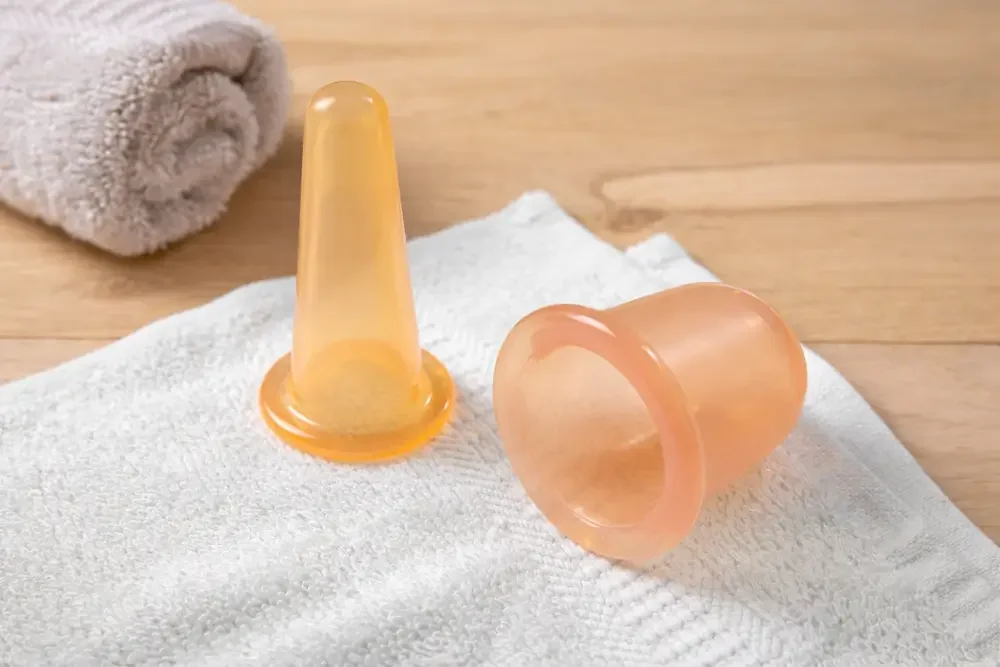
Silicone cups are the most common tool used for scar work: flexible, easy to control, and precise enough to calibrate suction to healing tissue. The therapist applies oil or lotion first, then places the cup against the skin and releases it to create a vacuum. Depending on the area and the goal, the cup may be held in one position, moved slowly across the tissue, or both.
What you will feel is a pulling sensation — a clear awareness of the tissue being lifted, not pain. Scar tissue that has been restricted for a long time may feel more intense in early sessions, and some post-treatment soreness is normal. The circular marks that appear afterward, often mistaken for bruises, reflect increased blood flow in the treated area and typically fade within a few days to two weeks.
Timing matters more than most patients realize. Cupping is not appropriate on tissue that has not fully healed. For post-surgical scars, treatment generally does not begin until at least 6–8 weeks after surgery and only once the incision is fully closed, always coordinated with the surgical team. Cupping as part of a clinical treatment plan follows the same logic: gradual, calibrated, and adjusted as the tissue changes.
No fixed number of sessions applies to everyone. Some patients see meaningful change within a few visits. Others, particularly those dealing with radiation fibrosis, axillary cording, or well-established adhesions, benefit from longer, sustained treatment. Your therapist will evaluate your tissue and build a plan around what it actually needs.
Why the Setting Matters as Much as the Technique
Cupping is widely available. Wellness studios, massage practices, and sports recovery centers offer it. For general muscle tension or workout recovery, those settings are appropriate. For post-surgical breast scars, care should be guided by a clinician trained in oncology and lymphatic rehabilitation. They need a full scar treatment and management program.
The tissue surrounding a mastectomy or lumpectomy scar exists in a specific clinical context. It may have been affected by radiation. Lymph nodes may have been removed nearby, making lymphatic function an active consideration, one that changes what treatment is appropriate and in what sequence. Nerves may have been cut or displaced, altering sensation in ways that affect how the tissue tolerates suction. None of these factors is part of a wellness protocol.
A Physical or Occupational Therapist who specializes in breast and lymphatic rehabilitation evaluates all of this before beginning treatment. Cupping is one tool within an individualized plan, applied by someone who understands the full picture of what the tissue has been through, not just the surface presentation.
There is a meaningful difference between a spa cupping session and clinical scar rehabilitation. That difference is the expertise of the person delivering it.
In clinical practice, cupping is not used in isolation. Therapists combine it with manual scar mobilization, myofascial release, and, in breast rehabilitation specifically, Manual Lymph Drainage (MLD) by certified therapists. The goal is always functional: not to erase the scar, but to restore what the scar is limiting.
You Do Not Have to Accept This as Your New Normal
If you are living with scar tightness, restricted shoulder movement, cording, or the persistent sense that your body hasn't fully recovered, whether your surgery was six weeks ago or six years ago, that is not something you simply have to outlast. It is addressable. And the earlier it is addressed, the better the outcomes tend to be.
Thera's therapists specialize in breast and lymphatic rehabilitation and see patients at their Midtown Manhattan location, serving the full Tri-State Area. No referral needed; New York State Direct Access allows you to book directly for your first 10 visits or 30 days, whichever comes first. After that, a PT or OT script from a physician is required.
Reach out to Thera to speak with a specialist.
Frequently Asked Questions:
-
Yes, with an important clarification. Cupping does not dissolve or remove scar tissue. What it does is reduce adhesions, the abnormal binding of scar tissue to the layers beneath it. By lifting those layers apart, cupping restores tissue mobility, reduces pulling and tightness, and supports collagen remodeling that makes scars softer and less restrictive over time. The scar remains; what changes is how it behaves and how it affects movement.
-
There is no fixed number. Scar tissue responds differently depending on the surgery, healing process, radiation exposure, and how long the restriction has been present. Some patients notice changes within a few sessions, while deeper adhesions, radiation fibrosis, or axillary cording typically require a longer course of treatment. Consistency matters more than any single session, as scar remodeling is a gradual process.
-
Yes, when performed by a trained specialist and at the appropriate stage of healing. Cupping is not used on unhealed tissue once the incision is fully closed and cleared by the surgical team. For patients who have had lymph node removal or radiation, additional clinical considerations apply, which is why treatment should be guided by a therapist with oncology training.
-
Standard cupping is used on healthy tissue for muscle tension or recovery. Cupping for post-surgical scar tissue is a clinical application that targets adhesions, tissue restriction, and, in some cases, lymphatic impairment. The technique may look similar, but the suction, timing, and clinical context are entirely different and are part of an individualized rehabilitation plan.
-
Most patients describe a pulling or lifting sensation rather than pain. Areas with long-standing restrictions may feel more intense initially, and mild soreness afterward is common. The circular marks left by cupping reflect increased blood flow and typically fade within a few days to two weeks. Suction is always adjusted to what the tissue can tolerate.
-
No. New York State Direct Access allows you to begin Physical Therapy or Occupational Therapy without a physician referral for the first 10 visits or 30 days, whichever comes first. After that, a prescription from a physician is required. If you are experiencing scar tightness, restricted movement, or cording after breast surgery, you can book directly without waiting for a follow-up appointment.
Sources
All clinical statistics and factual claims in this article are sourced from peer-reviewed research or academic medical institutions. Links are provided for verification.
Axillary web syndrome incidence (6%–86%) and 50% prevalence at 18 months: Koehler LA et al. — Axillary web syndrome following breast cancer surgery: symptoms, complications, and management strategies. Breast Cancer: Targets and Therapy, 2018. PMC6304256.
AWS prevalence 28.9%–50% in prospective studies; persistence up to 3 years: Ng et al. — Prevalence and associations of axillary web syndrome in Asian women after breast cancer surgery. BMC Cancer, 2021. PMC8439086.
Cupping as instrument-assisted soft tissue mobilization for axillary cording: Flourish Recovery & Wellness — Untangling the Strands: Axillary Cording (OT clinical practice). April 2025.
Scar tissue collagen structure, elasticity, and blood supply differences: MD Anderson Cancer Center — Scar massage after cancer treatment: 6 things to know.
Cupping mechanism (negative pressure, capillary response, collagen remodeling): NCBI Bookshelf — Vacuum Massage in the Treatment of Scars. Textbook on Scar Management, 2020.
Manual scar therapy including cupping: 8-week protocol outcomes: Lubczyńska et al. — Effectiveness of various methods of manual scar therapy. Skin Research and Technology, 2023.
Mastectomy scar size, complications, and PT role in scar healing: BreastCancer.org — Mastectomy and Lumpectomy Scars: Why They Form & More. Reviewed December 2024.
Axillary web syndrome: PT treatment approaches including scar mobilization: BreastCancer.org — Axillary Web Syndrome (Cording). Reviewed October 2023.
Cupping is one technique within our broader Scar Management & Prevention program. Patients recovering from breast surgery can also learn more about our full Breast Cancer Rehabilitation program, which integrates scar treatment with lymphatic care and mobility restoration.