
Author: Megan McCarthy
Most people expect bruising, swelling, and soreness after liposuction. Far fewer expect a burn. Yet liposuction burns — injuries to the skin caused by heat from surgical devices, or by heat applied to numb skin during recovery — are a recognized complication. The American Society of Plastic Surgeons lists thermal burn and heat injury among the known risks of the procedure.
When a burn does happen, patients often feel unsure of what they are looking at and anxious about what comes next. This guide explains, in general terms, how liposuction burns happen, what they typically look like, how surgeons usually treat them, and how physical and occupational therapy support recovery once the skin has healed.
An important note before you read on: this article offers general education only. It does not replace — and should never override — the instructions of your surgeon or physician. Every burn is different. If you suspect a burn after liposuction, contact your surgeon right away. At Thera Physical and Occupational Therapy in Midtown Manhattan, we work alongside your surgical team, never in place of it.
How Burns Happen After Liposuction
Liposuction burns generally fall into two groups: injuries that occur during the procedure and injuries that occur during recovery.
Burns From Energy-Assisted Devices
Many modern liposuction techniques use energy to loosen or melt fat before the surgeon removes it — ultrasound-assisted liposuction (UAL, including VASER), laser-assisted liposuction (LAL), and radiofrequency-assisted liposuction (RFAL). These devices generate heat beneath the skin. When that heat concentrates against the underside of the skin or at an incision site, it can injure the skin from the inside out. A published review of liposuction techniques (PMC4644740) lists thermal injury as a known drawback of ultrasound-, laser-, and radiofrequency-assisted methods.
The risk varies by technique. A 2024 systematic review in the European Journal of Plastic Surgery found that RFAL carried the highest pooled rate of thermal injury and blistering, at about 1.6 percent, while LAL showed the lowest, at about 0.1 percent. Burns remain uncommon — but they do occur.
Burns During Recovery
Liposuction often changes skin sensation for weeks or months. Numb skin cannot warn you when a heating pad, heat pack, or hot water bottle gets too hot. A case report in the Australasian Journal of Plastic Surgery describes a full-thickness abdominal burn from a heat pack after surgery that required skin grafting, and reviews similar heating-pad injuries in other post-surgical patients. Ice packs carry a parallel risk: numb skin cannot sense cold injury either.
Friction Injuries That Look Like Burns
Compression garments, foam, and lipo boards can rub or fold against swollen skin and cause friction blisters or abrasions. Patients often describe these as burns. They have a different cause, but they still need your surgeon's attention — and often a change in how your garment fits.
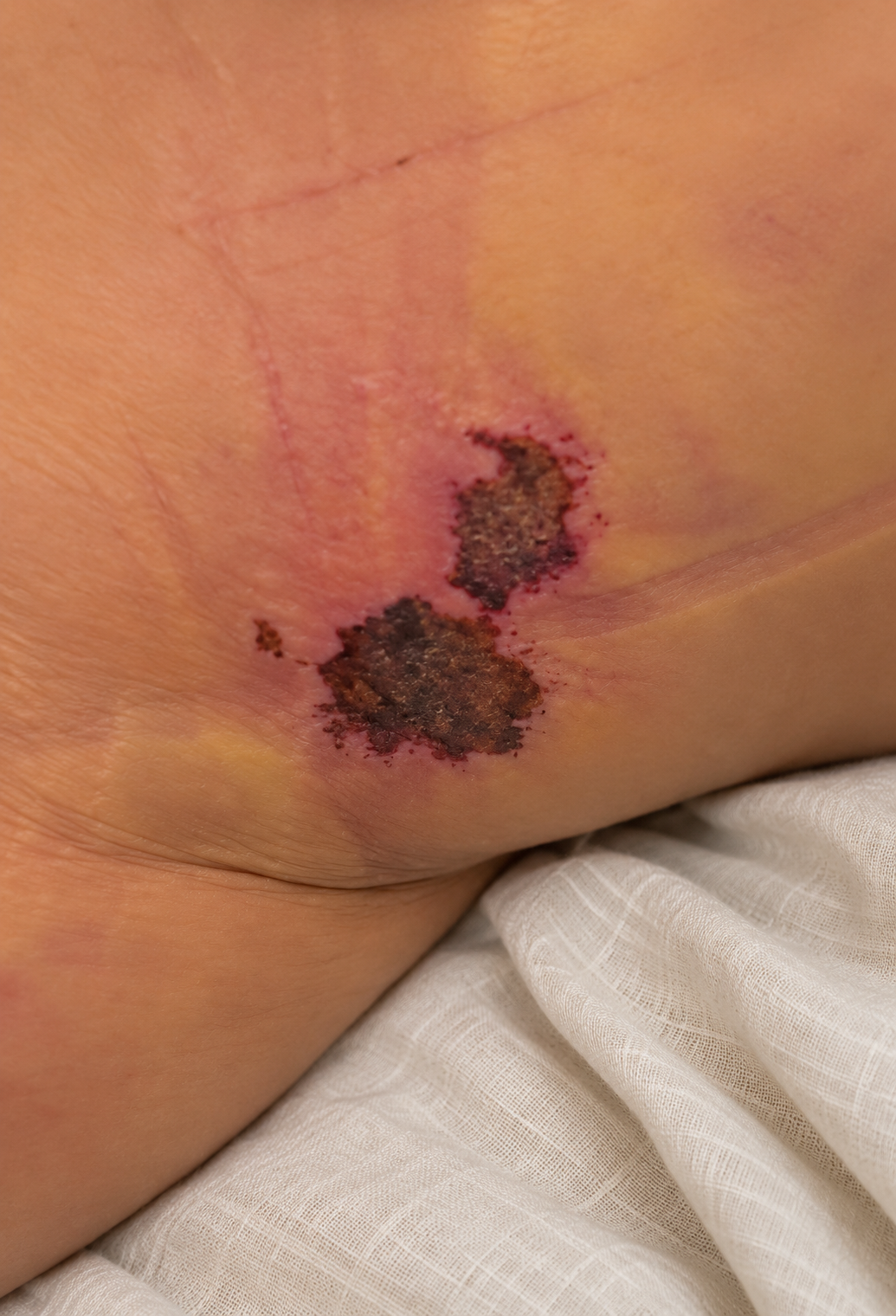
What Liposuction Burns Typically Look Like
Clinicians classify burns by depth — how many layers of skin the injury reaches. The Cleveland Clinic's guide to burns describes each category in detail. In general:
- Superficial (first-degree): redness, tenderness, and dryness limited to the top layer of skin, with no blisters
- Partial-thickness (second-degree): blisters, moist or weeping skin, and pink-to-red coloring; deeper partial-thickness burns may look blotchy or pale
- Full-thickness (third-degree): white, waxy, tan, leathery, or darkened skin that may feel firm to the touch
Two features make liposuction burns harder to read than everyday burns.
Numbness Hides the Warning Signs
Pain normally helps signal how deep a burn goes. After liposuction, the skin is often numb, so a serious burn may hurt far less than you would expect. Never use the absence of pain to judge how severe a burn is.
Burns Can Reveal Themselves Slowly
A burn from an internal energy device starts beneath the skin. Its full extent may take several days to become visible, and early discoloration can resemble ordinary post-surgical bruising. Bruises typically shift from purple to green to yellow and fade. A burn, by contrast, tends to blister, darken, harden, or develop a dry, crust-like surface. If you are unsure which you are seeing, ask your surgeon.
How Liposuction Burns Are Typically Treated
Your surgeon — and, for deeper burns, a burn or wound care specialist — directs treatment. The approach depends on the burn's depth, size, and location, but commonly includes:
- Assessment and monitoring, often with photographs over several days to track how the burn evolves
- Wound cleansing and dressings, including non-stick dressings and, when indicated, topical antimicrobial ointments or dressings to lower infection risk
- Blister management decided by your provider — not at home
- Compression adjustments, such as padding or modifying your garment so it does not press or rub on the wound
- Surgical care for deep burns, which may include debridement (removal of damaged tissue) and skin grafting
- Infection surveillance and pain management throughout healing
Practical Guidance While You Heal
- Never apply heat to treated areas unless your surgeon specifically approves it — and then follow their exact instructions
- Do not pop, drain, or peel blisters
- Skip home remedies such as butter, oils, toothpaste, or essential oils, and any over-the-counter cream your surgeon has not approved
- Check your skin daily, especially under garment seams and folds, and photograph anything new to share with your surgeon
- Report rubbing or pinching from your compression garment rather than cutting or removing it on your own
- Protect healing and healed skin from the sun — burns and scars can darken with UV exposure
When to Call Your Surgeon Right Away
Contact your surgeon promptly for spreading redness, warmth, increasing swelling, pus, a foul odor, fever or chills, skin turning white, gray, or black, or pain that grows worse instead of easing. For a medical emergency, call 911.
Where Physical and Occupational Therapy Fit In
Once your surgeon confirms the wound has closed and is stable, rehabilitation helps the skin and the tissue beneath it heal well. Our physical and occupational therapists coordinate directly with your surgeon, and care may include:
- Scar management — soft tissue mobilization and scar massage to improve skin pliability and reduce adhesion between skin and deeper layers
- Guidance on silicone and scar care products, in line with your surgeon's recommendations
- Manual lymphatic drainage (MLD), a gentle hands-on technique that moves fluid toward healthy lymph nodes, adapted to route around healing areas rather than over them — part of our lymphatic care and wellness services
- Compression garment assessment to reduce pressure points and friction
- Desensitization for skin that feels hypersensitive or numb
- Occupational therapy for daily life — garment donning, bathing, safe heat avoidance, and a graded return to work and exercise
Before a wound has closed, we treat only areas away from it, and only with your surgeon's approval.
Post-Surgical Recovery Care at Thera in NYC
At Thera, our physical and occupational therapists specialize in plastic and cosmetic surgery recovery. Our team includes Certified Lymphedema Therapists (CLT) and Certified Cosmetic Surgery Therapists (CCST) who understand how surgery, swelling, and scar tissue interact — and how to work safely around complications like burns.
Every session at Thera is one-on-one. We build your plan around your surgeon's instructions, your healing timeline, and your goals. Our Midtown Manhattan clinic at 115 West 30th Street sits steps from Penn Station, making it easy to reach from across New York City and the Tri-State Area.
Liposuction burns are uncommon, but they are real — and numb post-surgical skin can make them easy to miss. Know what to watch for, keep heat away from treated areas, and bring any concern to your surgeon quickly. Your surgeon directs burn treatment. Once the skin has healed, physical and occupational therapy can help you restore comfortable, flexible tissue and get back to your life.
If you are recovering from liposuction and have questions about scarring, swelling, or skin changes after a burn — and your surgeon has cleared you for therapy — contact our team today to schedule an evaluation at our Midtown Manhattan clinic.
No referral needed · NY State allows direct access to PT and OT for up to 10 visits or one month without a physician's script.